 EN

Grain bins on a farm
A rack on a barn feeding cart can be sized perfectly and still be scrap in two seasons. Ammonia, manure, fertiliser dust and the pressure washer do the damage.
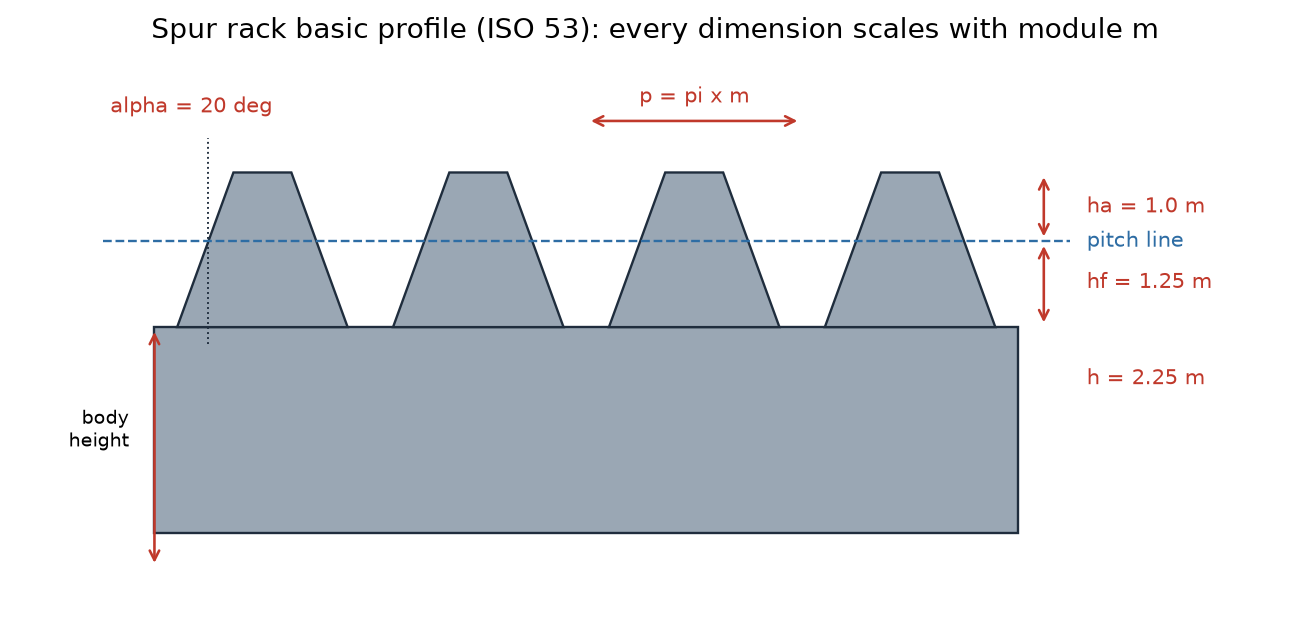
Spur rack profile for agricultural equipment
What attacks racks on farms
· Outdoor exposure: rain, condensation, temperature cycles.
· Livestock houses: ammonia and moisture from manure.
· Fertiliser and feed dust that holds moisture on the teeth.
· High-pressure cleaning that strips grease and drives water into joints.
The options
| Material | Strength | Corrosion | Notes |
| Hot-dip galvanised steel | High (steel core) | Good outdoors; zinc protects cut edges sacrificially | Coating adds thickness on flanks; teeth cut with allowance |
| 304 stainless | Moderate; not heat-treatable | Good | Wash-down, light loads |
| 316 stainless | Moderate; not heat-treatable | Better with chlorides (molybdenum) | Manure, fertiliser, coastal sites |
| 420 stainless | Hardenable | Moderate | When wear and corrosion both matter |
| Nylon | Lowest | No corrosion | Quiet, light gates and adjustments |
Practical rules
· Pick the material for the worst environment the rack sees, not the average.
· Avoid mixing stainless racks with plain carbon steel pinions in wet conditions; use matching or compatible materials.
· On galvanised racks, do not grind or weld after coating without touch-up.
· Use a grease that resists washing out, or run nylon/stainless dry on light duty.
· Mount racks so water drains off the teeth.
Summary
On agricultural equipment, specify the rack's material and finish first and the module second. Most failures are chemical, not mechanical.
For drawings, samples or a quotation, send us your rack, pinion or gear specification and quantity.
