 EN
EN

Choosing a gear rack for a greenhouse ventilation system looks like a dimensional exercise — find the right length, confirm the hole spacing, order. In practice most of the failures we are asked to diagnose come from taking those decisions in the wrong order: someone specifies the length first and finds the tooth pitch does not match, or matches the pitch and finds the section too light for the span.
Start With the Pinion, Not the Rack
The rack has to mesh with something. Whatever pinion is already on your drive shaft — or comes with the drive unit you are buying — defines the tooth geometry the rack must have. Everything else is negotiable; this is not.
Module describes tooth size. It is the ratio of the gear's pitch diameter to its tooth count, and it sets tooth height and spacing. Two racks can be identical in length, width, thickness and hole pattern and still be entirely incompatible because one is a different module from the pinion.
There is no partial compatibility here. A rack one module step away from the pinion will not run roughly — it will either refuse to seat or it will ride on tooth tips and strip within weeks.
How to Identify Module on an Existing Rack
If you are replacing a rack and have no documentation, work from the physical part.
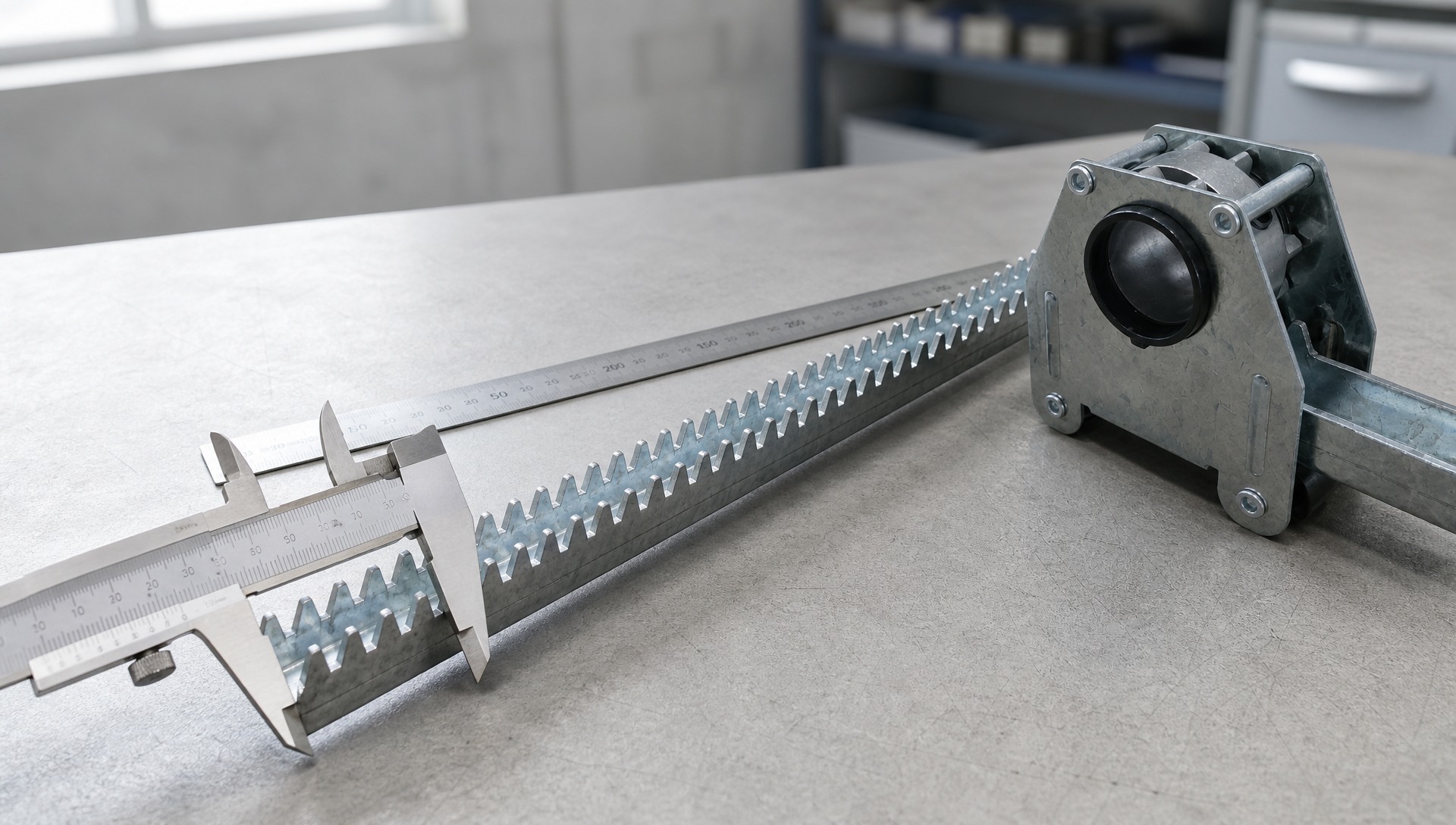
Measure tooth pitch directly. Pitch is the distance from one tooth to the same point on the next. Measuring across ten teeth and dividing by ten averages out your measurement error. Module is pitch divided by π.
Photograph the teeth against a scale. A clear photograph of the toothed edge alongside a steel rule or caliper is usually enough for a supplier to identify the form — the fastest route, and the one we recommend.
Check the mating pinion too. If the old rack is worn, its tooth profile has changed. A pinion in better condition is the more reliable reference.
Spur or Helical
Greenhouse racks are predominantly spur — straight-cut teeth perpendicular to the direction of travel. Helical racks exist in industrial linear motion but are uncommon here, for a specific reason: helical teeth generate axial thrust along the pinion axis. In a machine tool with thrust bearings that is manageable. On a greenhouse drive shaft with a pinion clamped by a set screw, it is a force trying to walk the pinion along the shaft, and over thousands of cycles it can do exactly that.
Never mix the two. A spur rack running against a helical pinion meshes on a point rather than across the tooth face — see how the drive system works. It appears to function on installation day and fails within a season.
Sizing Rack Length From Vent Travel
Rack travel is the linear distance the rack must move to take the vent from fully closed to fully open. Rack length is not the same figure — it must be longer, to cover three things:
Engagement allowance. The rack must stay properly meshed at both ends of the stroke. A rack cut exactly to the travel distance runs out of teeth at full opening, leaving the final teeth carrying the entire load where wind exposure is greatest.
Mounting and end details. Fixing points and the guide flange occupy length not available as working travel.
Installation tolerance. Greenhouse steelwork is not built to machine-shop tolerance, and margin lets the installer position the rack correctly.
To determine the travel itself, work back from the vent geometry: opening angle, sash dimensions, and the push rod and support arm linkage. The relationship between travel and opening angle is not linear across the stroke, because the support arm swings through an arc — see how the drive system works. If you are matching an existing installation, measure the old rack instead of recalculating.
Roof Vent Racks vs Side Vent Racks
The same rack form serves both positions, but selection emphasis differs.
Selecting a Greenhouse Roof Vent Rack
A greenhouse roof vent rack works against gravity throughout its stroke and against wind load on the raised sash. Wind is the governing case, not sash weight. Priorities for roof positions:
• Section stiffness, because the load varies with weather rather than staying constant
• Coating quality, because ridge positions see the heaviest condensation in the house
• Consistency across the run, because one shaft drives a whole row and every rack must engage identically
Selecting a Greenhouse Side Vent Rack
A greenhouse side vent rack carries a lower gravity load, since the sash swings rather than lifts, but it sits where splash and airborne dust reach the teeth continuously. Priorities for sidewall positions:
• Tooth accessibility for cleaning, because debris in the tooth root is the dominant maintenance issue here
• Resistance to standing water, since sidewall components see splash rather than just condensation
• Ease of individual replacement, because sidewall racks tend to need attention before roof racks do
Load: What the Rack Is Actually Working Against
Three loads act on the rack. Static load — the weight of sash and linkage — is the easiest to calculate and usually the smallest. Wind load on the open sash is the largest and least predictable, and it is what the system should be sized against; use the design wind speed for your site. Snow and ice load applies in cold climates, and the damaging case is not added weight but ice binding the sash to its frame: the mechanism tries to break a frozen joint free, and the entire breakout force lands on the teeth in mesh at that instant.
On published load ratings: a rack's capacity depends on module, material, tooth width, heat treatment and support spacing. A single "maximum load" figure quoted without those conditions is not a usable engineering number. If load capacity is critical, ask for it against your specific configuration rather than accepting a headline value.
Corrosion Resistance and Greenhouse Humidity
Greenhouses are one of the more aggressive environments ordinary steel is asked to survive — not because conditions are extreme but because they cycle relentlessly. Warm humid air meets cooler metal at night, condensation forms, the surface dries the following morning, and this repeats for the life of the structure.
Zinc coating is the standard answer. Zinc protects sacrificially: where the coating is scratched, the surrounding zinc corrodes preferentially rather than letting corrosion undercut the coating the way a paint film allows.
What actually determines rack life, though, is usually not the coating specification:
• Standing water in the tooth roots does far more damage than humid air. Racks that drain outlast racks that hold water.
• Trapped debris holds moisture against the surface continuously, defeating the wet-dry cycle that keeps zinc passivated.
• Chemical exposure where fertiliser or pesticide spray reaches the rack can change the appropriate treatment.
Coastal sites and high-humidity crop production warrant discussing surface treatment specifically.
Section Profile and Rack Stiffness
Racks are commonly produced in an L-shaped section: a flat vertical web with teeth formed along one edge. The web adds bending stiffness along the rack length and gives a continuous mounting face — see the greenhouse gear rack specifications.
Stiffness matters because of what happens to an unsupported span. A rack that sags between supports loses engagement depth at mid-travel while remaining correctly meshed at both ends, producing the confusing symptom of a vent that runs smoothly at the start and end of its stroke but binds in the middle. Two variables address this: section depth and support spacing. On longer runs, adding intermediate support is usually more effective than specifying a heavier section, and it is cheaper.
Installation and Alignment
More greenhouse rack failures come from installation than from specification.
Alignment is the critical variable. The rack must run parallel to its direction of travel. A rack installed at even a slight angle binds partway through the stroke and loads one side of the pinion teeth. When a vent shows resistance at one specific point in its travel — not throughout — that is alignment, not insufficient motor torque, and increasing torque converts a geometry problem into a broken tooth.
Engagement depth must be right. The pinion should engage the full tooth depth, not ride on tooth tips, which is where teeth break.
Support the span, following the spacing appropriate to the section and length.
Run the stroke by hand first. Any resistance or shallow-looking engagement is far cheaper to fix before the motor is applying torque.
Set consistent phase across a run. Where one shaft drives multiple vents, every matching pinion drive unit must be clamped in the same phase so the vents track together.
Maintenance That Actually Extends Rack Life
Keep the tooth roots clear. This single item outweighs everything else. Debris packed into the tooth gaps is the most common cause of stiff operation, and the wear it causes gets misdiagnosed as a worn rack.
Be cautious with grease. In a dusty greenhouse, grease traps grit and turns it into a grinding compound. Many installations run better dry and clean.
Inspect engagement seasonally. Mounting hardware loosens over time and engagement can drift shallow without any obvious symptom.
Watch for uneven tooth wear. Wear concentrated on one side of the tooth face indicates misalignment — correct the alignment rather than just replacing the rack.
When to Replace Rather Than Repair
Replace the rack when:
• Teeth are visibly worn thin, chipped or missing. Tooth geometry cannot be restored.
• The rack is bent or twisted. Straightening work-hardens the steel and rarely restores true alignment.
• Corrosion has penetrated the tooth section. Surface staining is cosmetic; section loss is structural.
• Wear is concentrated at one point. Find and fix the cause, or the replacement wears the same way.
Repair or adjust instead when the symptom is stiffness with sound teeth, shallow engagement from loose mounting, or debris accumulation. Those are alignment and cleaning problems, and a new rack will not fix them.
When ordering a greenhouse rack replacement, send the old rack's length, hole spacing, a photograph of the tooth profile against a scale, and a photograph of the mating pinion.
A Practical Specification Checklist
Before requesting a quotation, gather:
1. Module or tooth pitch — or a photo of the teeth against a scale
2. Tooth form — spur or helical
3. Required rack travel — the full opening stroke
4. Overall rack length — travel plus engagement and mounting allowance
5. Section dimensions — height and thickness, or the profile to match
6. Mounting hole pattern — spacing and diameter
7. Vent type — roof or side
8. Quantity — per vent and total
9. Environment — coastal, high humidity, chemical exposure
10. Drive shaft diameter — if the drive unit is included
With those ten items a supplier can quote accurately. Without the first two, no quotation is meaningful.
FAQ
Q: What module gear rack should I use for a greenhouse vent?
Whatever module your pinion is. There is no universal greenhouse standard to default to. If you are specifying a new system, rack and pinion are chosen together as a matched pair.
Q: How long should a greenhouse gear rack be?
Long enough for the full vent travel plus engagement allowance at both ends plus mounting details. Sizing a rack exactly to the travel distance leaves the end teeth carrying full load at full opening.
Q: Can I use the same rack for roof vents and side vents?
Often yes, if the travel and mounting arrangement suit both. The selection emphasis differs — roof racks are governed by wind load and condensation, side racks by contamination and cleaning access — but the same part frequently serves both.
Q: How do I know if my greenhouse rack needs replacing or just adjusting?
Inspect the teeth. Sound teeth with stiff operation means alignment or debris. Worn, chipped or missing teeth means replacement. Uneven wear across the tooth face means replacing the rack and correcting the alignment that caused it.
Q: Does a galvanized rack need painting as well?
No, and painting over zinc is usually counterproductive. Paint fails first at the tooth flanks where contact occurs each cycle, and once breached it holds moisture against the steel.
Q: What causes a greenhouse vent to open smoothly at first and then bind?
Almost always geometry in the middle of the stroke: a sagging rack losing engagement depth between supports, or a rack not parallel to its travel direction. Check alignment and support spacing before considering a more powerful motor.
Q: Should I replace all the racks in a bay or just the failed one?
If one rack failed from a localised cause, replace that one and fix the cause. If several show similar wear, the whole run is at the same point in its life and staged replacement is usually more economical than repeated call-outs.
Conclusion
Selecting a greenhouse gear rack comes down to a short sequence, taken in order. Confirm tooth geometry against the pinion first, because nothing else matters if the rack will not mesh. Size the length from actual vent travel with proper allowance at both ends. Weight the selection toward wind load rather than static weight. Specify a coating appropriate to a permanently condensing environment, and pay attention to drainage and debris, which affect service life more than coating grade does.
Then install it straight and support it properly — because alignment causes more rack failures than specification ever does.
If you are matching an existing installation, the shortcut through all of this is a photograph of the tooth profile against a ruler plus the overall length. That single photograph resolves the question that most often makes an order wrong.
