EN
EN

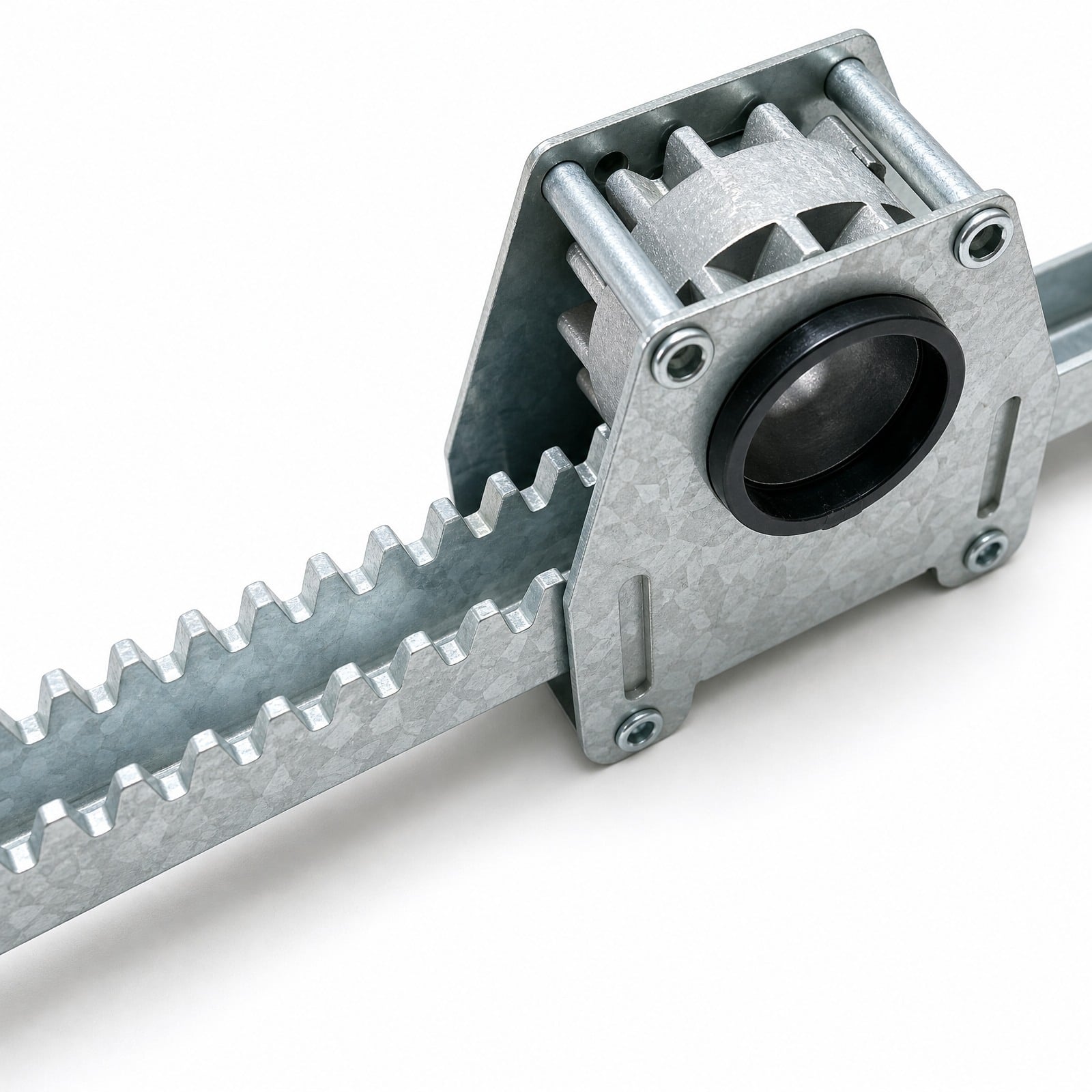
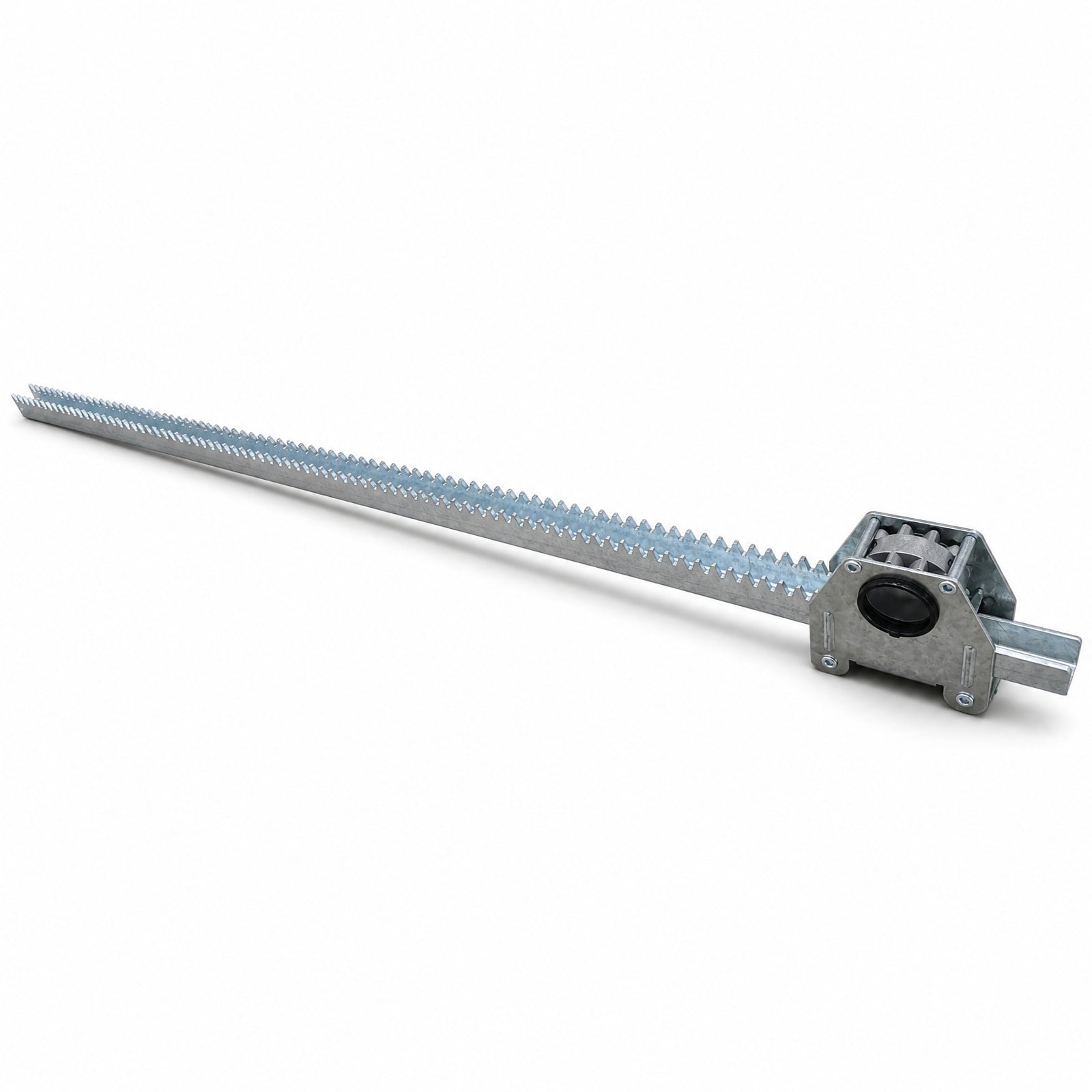
In a greenhouse ventilation system, the gear rack is the component that actually moves the vent. A gear motor turns a drive shaft, a pinion mounted on that shaft rotates, and the rack — meshed with the pinion — travels linearly. That travel is transferred through a push rod to the vent sash. Everything upstream is rotation; the rack is where rotation becomes the stroke that opens the window.
This greenhouse gear rack is produced in galvanized steel with a straight-cut (spur) tooth profile. The teeth are formed along one edge of an L-shaped section: a flat vertical web serves as the mounting and stiffening face, while the toothed edge engages the pinion. Compared with a flat bar rack of the same material thickness, the L-section resists the bending and twisting that occurs when a long vent run loads the rack off-centre.
The leading end of the rack is formed with a guide flange, which lets the rack enter the channel of the drive unit cleanly during installation and helps keep the rack seated as it travels. The rack is designed to run inside the C-channel of a matching compatible drive unit, where guide pins on both sides of the pinion hold the rack in mesh and prevent it from lifting out under load.
Greenhouse environments are consistently humid, and condensation on steel components is normal rather than exceptional. The rack is supplied zinc coated for that reason. For growers running high-humidity crops or coastal installations, tell us the condition at enquiry stage — surface treatment can be specified accordingly.
For the underlying mechanics of how the motor, shaft, pinion and rack work together across a full vent run, see our article on the working principle of rack and pinion vents.
• Straight-cut spur teeth — engages a matching spur pinion. No helical geometry, so there is no axial thrust pushing the pinion sideways on the drive shaft.
• L-shaped section — the flat web adds bending stiffness along the rack length and provides a continuous mounting face.
• Galvanized finish — zinc coated for service in the permanently humid greenhouse atmosphere.
• Formed guide flange at the leading end — assists entry into the drive unit channel and helps maintain engagement.
• Designed as a matched pair — supplied alongside the drive unit so the tooth pitch of the rack and pinion are confirmed as compatible before shipment.
• Made to drawing — length, hole pattern and section can follow your existing specification for retrofit work.
Greenhouse Gear Rack — Confirmed Specifications
| Product Type | Greenhouse gear rack (straight / linear) |
| Tooth Profile | Straight-cut spur teeth |
| Section Profile | L-shaped — flat web with toothed edge |
| End Detail | Formed guide flange at leading end |
| Material | Steel |
| Surface Treatment | Zinc coated (galvanized) |
| Application | Greenhouse roof vent and side vent drive systems |
| Mating Component | Spur pinion housed in greenhouse rack and pinion drive unit |
| Module / Tooth Pitch | Please contact us for detailed specifications |
| Rack Length | Available according to drawing — custom lengths available |
| Rack Height & Thickness | Please contact us for detailed specifications |
| Mounting Hole Pattern | Available according to drawing |
| Weight per Piece | Please contact us for detailed specifications |
Steel with a zinc-coated (galvanized) finish. The zinc layer is the primary defence against the condensation cycle that greenhouse steelwork is exposed to every day — warm humid interior air meeting a cooler metal surface at night.
Steel grade, coating method and coating weight are confirmed per order. If your project specifies a particular grade or coating standard, send the requirement with your enquiry and we will confirm against it rather than assume.
Available Sizes
Rack length is available according to drawing. Vent bay width, the number of sashes driven by one shaft and the required stroke all vary between greenhouse designs, so the rack is cut and drilled to suit the run rather than sold in a fixed catalogue length only.
For a replacement on an existing structure, the fastest route is to send the length of the old rack, the hole spacing and a photo of the tooth profile. Send your requirement to confirm available lengths for your project.
Gear Module
The tooth profile is straight-cut spur. Please contact us for the module and tooth pitch — this is the single most important figure to confirm before ordering, because a rack whose pitch does not match your existing pinion will not mesh, regardless of whether the length and hole pattern are correct.
If you are replacing a rack and do not know the module, send a clear photo of the toothed edge alongside a ruler or caliper. That is usually enough for us to identify it.
Rack Length
Manufactured to the length required by the vent run. Custom lengths available. On longer vent bays, racks are commonly installed in series along the same drive shaft, with each rack section driven by its own pinion — see the rack selection guide for how stroke and bay width affect the length you need.
Pinion Compatibility
This rack is intended to run with the spur pinion fitted inside our greenhouse rack and pinion drive unit, and rack and drive unit are normally quoted together as a matched set so that tooth engagement is verified before dispatch.
The rack can also be supplied for an existing installation, but in that case the pinion data must be confirmed first. A spur rack must run with a spur pinion — a helical pinion will not mesh correctly with this tooth form, and forcing a mismatched pair causes rapid tooth wear and eventual tooth failure under load.
Surface Treatment
Zinc coated. The galvanized surface is visible in the product photographs as the characteristic spangled finish. Coating specification is confirmed at order stage; if your installation is coastal, or the house runs sustained high humidity such as in vegetable production, state this at enquiry so the appropriate treatment is quoted.
Mounting / Installation
The rack is fitted to the moving part of the vent assembly and passes through the channel of the drive unit, where it engages the pinion. In summary:
• Alignment first — the rack must sit parallel to its direction of travel.
• Full tooth engagement — the pinion must engage the full tooth depth, not ride on tooth tips.
• Support along the run — long racks need intermediate support so the span does not sag.
• Check the stroke dry — move the assembly by hand through the full range before connecting the gear motor.
Alignment, support spacing and stroke checking are covered in detail in our rack selection guide.
Mounting hole pattern is made to drawing so the rack can match the fixing points on your existing sash or push rod arrangement.
• Multi-span commercial greenhouses (Venlo and similar truss structures)
• Vegetable production greenhouses
• Glass greenhouses
• Polycarbonate sheet greenhouses
• Film-covered multi-span greenhouses
• Retrofit and replacement of worn racks in existing ventilation runs
Greenhouse Roof Vent Application
On roof vents, the rack drives the sash that lifts along the ridge. The drive shaft runs the length of the bay, and a pinion at each vent position converts shaft rotation into rack travel, which pushes the sash upward through a support arm.
Roof vent racks work against gravity and, more significantly, against wind load on the raised sash. Because a single shaft typically drives a whole row of vents together, the racks along that row must be installed consistently — if one rack engages differently from its neighbours, that vent position carries a disproportionate share of the load. Roof installations also see the heaviest condensation, since the ridge is where warm humid air collects.
Greenhouse Side Vent Application
On side vents, the rack drives a vertically or horizontally hinged sash in the sidewall. Side vent racks generally work against less gravity load than roof racks, but they operate in the dirtiest part of the structure — closer to ground level, more exposed to soil splash, irrigation spray and airborne dust.
The practical consequence is maintenance rather than strength: side vent racks accumulate debris in the tooth gaps faster, and debris packed into the tooth root is a common cause of stiff or jerky operation long before any real wear has occurred.
Customization
The following can be specified to your requirement:
• Rack length
• Mounting hole pattern and spacing
• Section dimensions to match an existing profile
• Surface treatment for higher-corrosion environments
• Supply as rack only, or as a matched rack and drive unit set
Send a drawing, a sample, or dimensioned photographs of the part you are replacing. Where no drawing exists, a photo of the tooth profile against a scale plus the overall length is normally enough for us to work from.
Q: What module is this greenhouse gear rack?
The module and tooth pitch are confirmed per order rather than published as a single fixed figure. If you are matching an existing pinion, send a photo of the tooth profile against a ruler or caliper and we will confirm compatibility before quoting.
Q: Is this a straight rack or a curved rack?
This is a straight rack with straight-cut spur teeth. Curved racks are used in some vent geometries but are a different product.
Q: Can I use this rack with a helical pinion?
No. A spur rack requires a spur pinion. Pairing it with a helical pinion wears the teeth quickly and can shear them under wind load — the working principle of rack and pinion vents explains why.
Q: What lengths are available?
Racks are supplied to drawing. Send the vent bay width and the required opening stroke, or the dimensions of the rack you are replacing.
Q: Will this rack fit my existing greenhouse ventilation system?
It depends on three things: tooth pitch, section dimensions and hole pattern. Send photographs and measurements of the existing rack and we will confirm whether a direct replacement is possible or whether it needs to be made to drawing.
Q: How do I stop the rack from rusting?
The rack is supplied zinc coated, which handles normal greenhouse humidity. What shortens rack life in practice is not the atmosphere but standing water and trapped debris in the tooth gaps. Keeping the toothed edge clear does more for service life than any coating upgrade.
Q: Do you supply the pinion and drive unit as well?
Yes. The rack is normally quoted together with the compatible drive unit so that engagement is confirmed as a set.
Why Choose Us
• Manufacturer and exporter since 2008. Tianjin Haorongshengye Electrical Equipment Co., Ltd. designs and produces transmission components including sprockets, timing pulleys, roller chain, gears and gear racks, and exports them directly.
• Rack and drive unit are matched before dispatch. Tooth engagement is confirmed as a pair rather than left for the installer to discover on site.
• We work from your drawing or your sample. Length, hole pattern and section are made to the installation, which matters for retrofit where the existing structure cannot be modified.
• We publish only what we can confirm. Where a figure has not been verified against the physical part, this page says so instead of printing a number.
• Replacement support. Send photographs and measurements of a worn rack and we will identify whether it can be matched.