 EN
EN

Double pitch chain comes in two forms at every size, and the difference is one dimension: the roller.
C2040 has a 0.312 inch roller. C2042 has a 0.625 inch roller. Everything else, the pitch, the plates, the pins, the breaking load, is identical.
The large roller version weighs 71% more and costs more. It does not carry more load. Understanding what you are actually buying is the difference between a conveyor that works and one that drags.
Published dimensions for the standard small roller series:
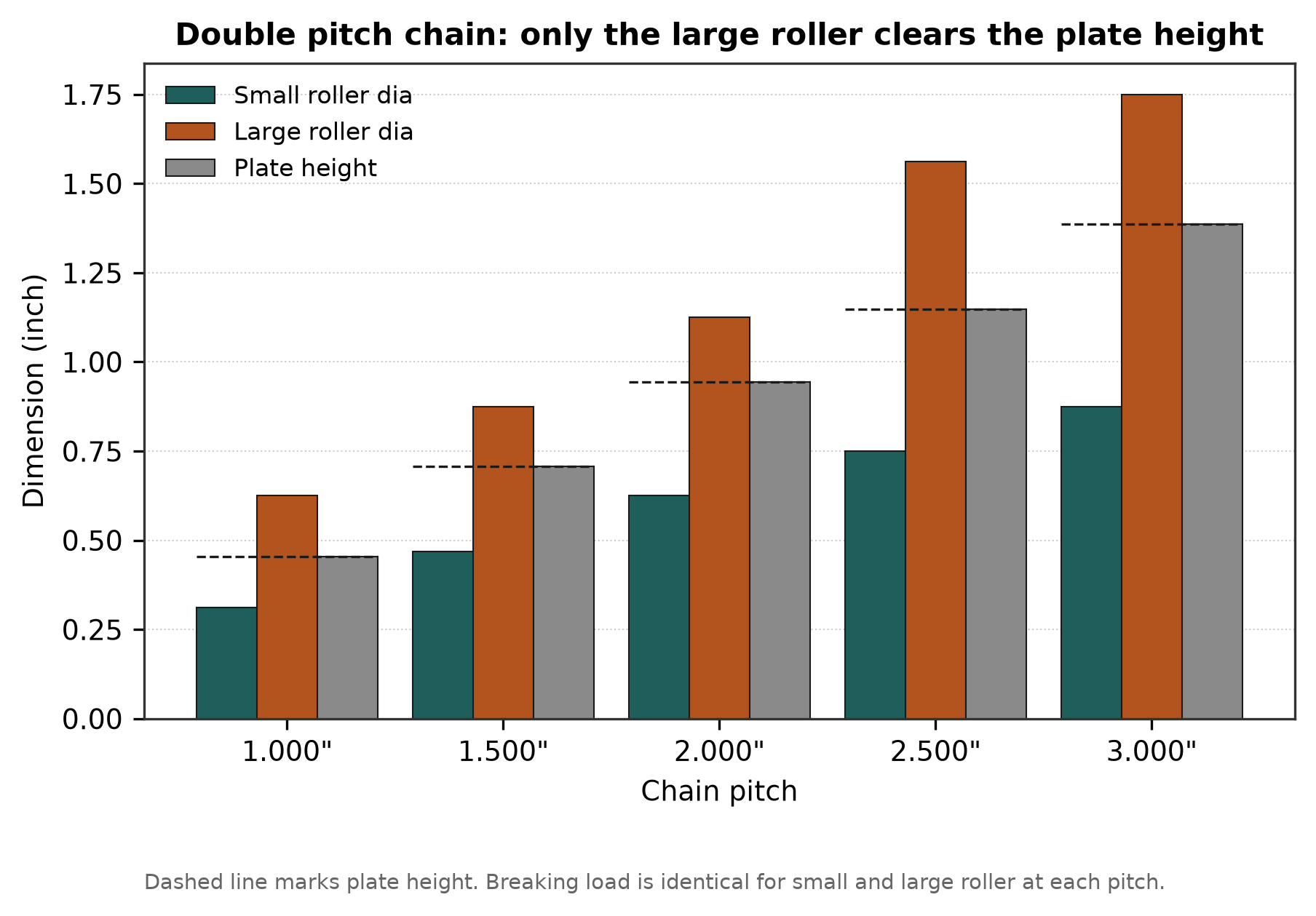
Only the large roller stands proud of the plate, which is what lets it run on a track.
| Chain | Pitch | Roller dia | Plate height | Min breaking load | Weight |
| C2040 | 1.000" | 0.312" | 0.455" | 3,108 lb | 0.34 lb/ft |
| C2050 | 1.250" | 0.400" | 0.570" | 4,894 lb | 0.56 lb/ft |
| C2060H | 1.500" | 0.469" | 0.707" | 7,010 lb | 1.01 lb/ft |
| C2080H | 2.000" | 0.625" | 0.943" | 12,500 lb | 1.67 lb/ft |
| C2100H | 2.500" | 0.750" | 1.148" | 19,907 lb | 2.42 lb/ft |
| C2120H | 3.000" | 0.875" | 1.386" | 28,549 lb | 3.43 lb/ft |
And the oversized roller series:
| Chain | Pitch | Roller dia | Plate height | Min breaking load | Weight |
| C2042 | 1.000" | 0.625" | 0.455" | 3,108 lb | 0.58 lb/ft |
| C2052 | 1.250" | 0.750" | 0.570" | 4,894 lb | 0.89 lb/ft |
| C2062H | 1.500" | 0.875" | 0.707" | 7,010 lb | 1.46 lb/ft |
| C2082H | 2.000" | 1.125" | 0.943" | 12,500 lb | 2.37 lb/ft |
| C2102H | 2.500" | 1.562" | 1.148" | 19,907 lb | 3.90 lb/ft |
| C2122H | 3.000" | 1.75" | 1.386" | 28,549 lb | 5.43 lb/ft |
Line them up and the point becomes obvious. The breaking loads are identical. 3,108 lb for both C2040 and C2042. 12,500 lb for both C2080H and C2082H. Every pair matches.
What changes is the relationship between the roller and the plate:
| Pitch | Small roller | Large roller | Plate height | Roller clears plate? |
| 1.000" | 0.312" | 0.625" | 0.455" | Large roller only |
| 1.500" | 0.469" | 0.875" | 0.707" | Large roller only |
| 2.000" | 0.625" | 1.125" | 0.943" | Large roller only |
| 3.000" | 0.875" | 1.75" | 1.386" | Large roller only |
On the small roller chain, the roller sits below the top of the plate. On the large roller chain it stands proud of it. That single fact is the whole design intent, as the published description says:
This style of roller chain utilizes an enlarged roller that exceeds the height of the sidebars. The design allows for smooth, easy conveyance of the product from one point to another.
The large roller can run on a track. The small roller cannot, because the plates would drag on the track before the roller touched it.
You buy large roller chain to get rolling contact with a support rail. That matters when:
· The chain carries load directly along a supported run
· Friction on a long conveyor would otherwise require a much larger motor
· The chain runs in a channel or on an angle track
You buy small roller chain when the chain is a drive element rather than a load carrier, or when the load is carried by slats, buckets or attachments rather than by the chain itself.
The weight penalty is not trivial: 42% to 71% depending on size. On a 50 metre conveyor loop that is real mass to accelerate and real load on the return run.
There is a logic to the roller sizes that helps when identifying unmarked chain.
Small roller double pitch uses the roller from the standard chain of half its pitch. C2040 has a 1.000 inch pitch and a 0.312 inch roller, which is the ANSI #40 roller at 0.500 inch pitch.
Large roller double pitch uses the roller from the standard chain at its own pitch. C2042 has a 1.000 inch pitch and a 0.625 inch roller, which is the ANSI #80 roller. Published confirmation:
The roller outer diameter of the C2042 corresponds to the No.80 standard roller chain since they both have a chain pitch of 25.4mm.
So if you have unmarked double pitch chain and can measure the roller, you can work out which family it belongs to.
The B series equivalents follow the same doubling principle. 08B has a 12.70 mm pitch; 208B has 25.40 mm, exactly double.
| Chain | Pitch | Roller dia | Plate height | Plate thickness | Breaking load |
| 208B | 25.40 mm | 8.51 mm | 11.18 mm | 1.6 mm | 1,760 kg |
| 210B | 31.75 mm | 10.16 mm | 13.80 mm | 1.58 mm | 2,270 kg |
| 212B | 38.10 mm | 12.07 mm | 15.75 mm | 1.81 mm | 2,950 kg |
| 216B | 50.80 mm | 15.88 mm | 21.00 mm | 3.60 mm | 6,120 kg |
| 220B | 63.50 mm | 19.05 mm | 26.30 mm | 4.40 mm | 9,690 kg |
| 224B | 76.20 mm | 25.40 mm | 33.30 mm | 5.00 mm | 16,310 kg |
Metric double pitch chain often carries an "A" prefix on the part number, and it uses the dog bone plate shape, waisted between the pin holes because the material there carries less stress than at the holes themselves. If you see a figure-eight plate profile, you are looking at double pitch chain.
The saving is structural. A double pitch chain covers twice the distance per link as a standard chain of the same roller size, using half as many plates, pins and bushes per metre.
The published rationale:
Double-pitch series roller chains are most commonly used in conveyor systems due to the per-linear-foot cost savings without sacrificing strength compared to single-pitch series chains.
You can verify the weight side of that claim from the tables. C2040 at 0.34 lb/ft covers an inch of conveyor per pitch; a standard #40 chain needs two pitches to cover the same inch, with twice the hardware.
Double pitch chain is not a general substitute for standard chain. The longer pitch means more chordal action at a given sprocket tooth count, which means more speed variation and more vibration.
Chordal action scales with pitch relative to sprocket diameter. Doubling the pitch without doubling the sprocket size doubles the polygon effect. This is why double pitch chain lives in slow conveying applications and not in power transmission drives.
We should be honest about the limit of what we can state here: the physical mechanism is well established, but a specific published maximum speed figure for double pitch chain was not something we could verify from a primary source. Take the speed rating from your chain supplier's data for the specific size and sprocket combination rather than assuming a general figure.
Work through this:
1. Does the chain run on a track? If yes, large roller. If no, small roller and save the weight.
2. What tension does the drive see? Both variants have the same breaking load at a given size, so this decides the pitch, not the roller.
3. How fast? Slow conveying suits double pitch. If you are near the speed limit, move to standard pitch chain rather than accepting the vibration.
4. What attachments? Attachment availability differs by series; confirm before committing to a size.
5. Imperial or metric? The C-series and B-series are not interchangeable and take different sprockets.
Can I fit C2042 where C2040 is currently running?
Mechanically the pitch and sprocket match, but the larger roller needs clearance. Check the guarding and any track before assuming it drops in.
Is C2042 stronger than C2040?
No. Both have a 3,108 lb minimum breaking load. The large roller adds track-rolling capability and weight, not strength.
Why is my double pitch chain vibrating?
Most likely chordal action from too few sprocket teeth for the pitch. Double pitch chain amplifies this. Increasing the sprocket tooth count is usually the fix.
What is the dog bone plate shape for?
It removes material from the waisted region between the pin holes, where stress is lower than at the holes. It saves weight without reducing strength.
Can I use standard #40 sprockets with C2040 chain?
No. Double pitch chain needs double pitch sprockets. Some double pitch sprockets are designed so that alternate teeth engage, which affects wear distribution; confirm the type with your supplier.
Which is more common in food conveying?
Large roller, because food conveyors usually support the load on a track or slat system. Note that stainless double pitch has its own much lower working loads.
Tianjin HaoRongShengYe Electrical Equipment Co., Ltd. produces double pitch conveyor chain in both small roller and large roller construction, in carbon steel and stainless, with attachments and matching sprockets. Tell us whether the chain runs on a track and what it carries, and we will specify the roller type rather than defaulting to the heavier one.
