 EN
EN

Most timing pulley enquiries specify the profile and the tooth count and leave the material blank, or say "aluminium" without qualifying it. That is usually fine for a light duty conveyor. It causes problems when the drive is fast, hot, wet, or carrying real torque.
Here is what each material actually gives you, with published figures.
Pulley manufacturers list 6061, 6082, 7075, 6063 and free-machining grades such as 2011 and AlCuMgPb. 6061-T6 is the workhorse.
Published 6061-T6 properties:
| Property | Value |
| Tensile strength | 310 MPa |
| Yield strength | 270 to 276 MPa |
| Hardness | 93 to 95 HB |
| Density | 2.7 g/cm³ |
| Max mechanical service temperature | 170 °C |
The number that matters is the hardness. 93 to 95 HB is soft. A timing belt has tensile cords and a fabric or rubber tooth face, and the fabric is abrasive. Run a belt against bare aluminium teeth for long enough at load and the aluminium wears, the tooth profile opens up, and backlash grows.
This is why anodising exists on pulleys, and it is where a lot of people get caught.
Two types matter, both under MIL-PRF-8625:
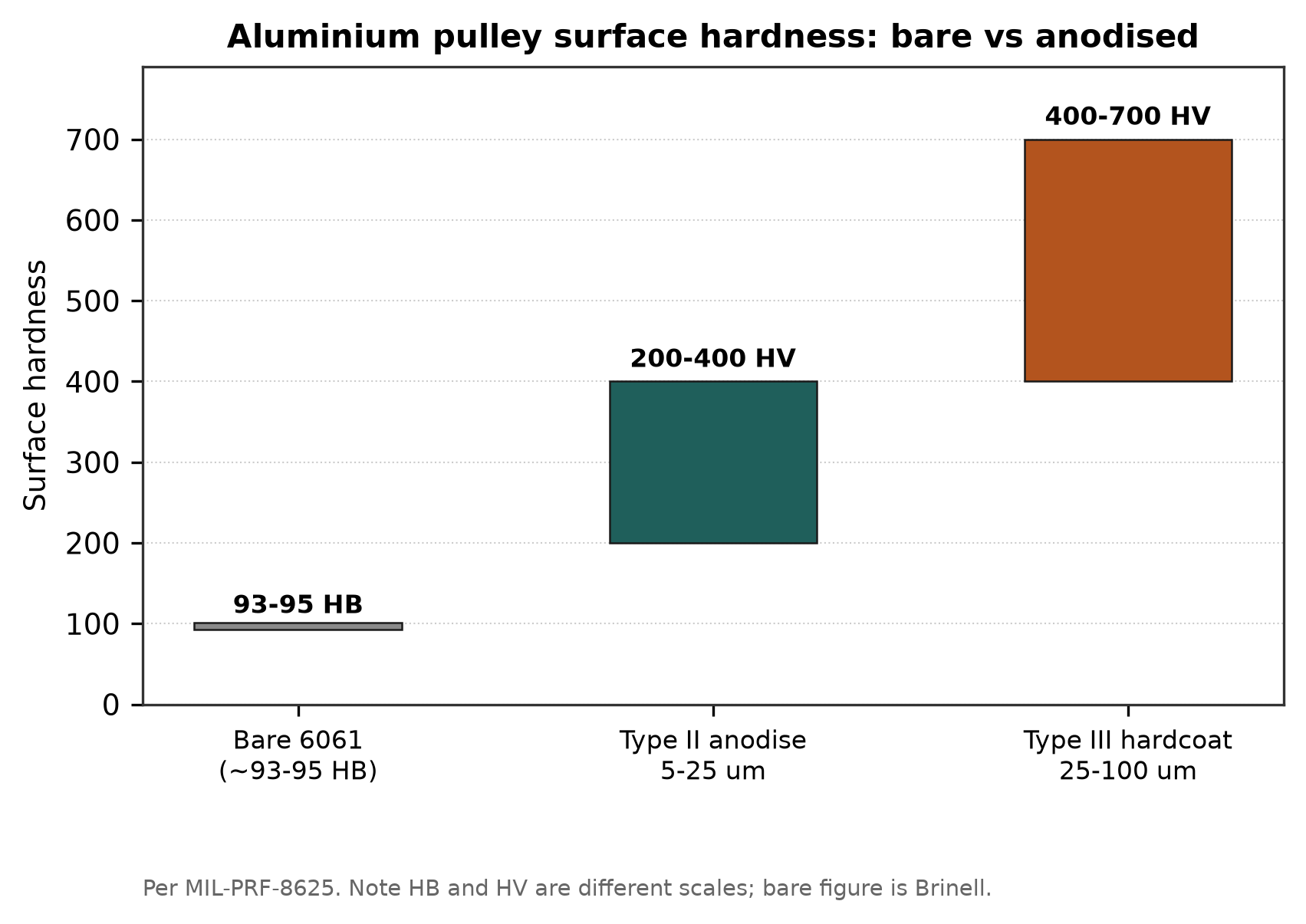
Surface hardness of bare, anodised and hard anodised aluminium.
| Type | Thickness | Surface hardness | Typical use |
| Type II (sulfuric) | 5 to 25 µm | 200 to 400 HV | General protection, cosmetic finish |
| Type III (hardcoat) | 25 to 100 µm | 400 to 700 HV | Wear surfaces, sliding fits, industrial wear parts |
Against bare 6061 at 93 to 95 HB, that is a large improvement. Type III hardcoat is the specification for a pulley that has to survive abrasive belt contact.
Now the trap. Anodising is not a coating applied on top of the part. It converts the surface, and it grows:
Anodizing grows 50% into the material (penetration) and 50% outward (buildup).
Dimensional growth is approximately 50% of total coating thickness per side.
Worked from the published example: a Type II coating at 0.5 mil total gives about 6.35 µm buildup per side, 6.35 µm penetration, and a total diametral change of about 12.70 µm. For Type III at 2.0 mils, expect about 1.0 mil per side.
On a timing pulley, that growth lands on the tooth flanks. A hardcoated pulley machined to nominal dimensions before anodising comes out of the tank with tighter tooth spaces than drawn. On fine pitch profiles such as T2.5 or AT3, tens of microns on each flank is a meaningful fraction of the tooth space.
The fix is straightforward but it has to be deliberate: machine the tooth form undersize by the expected growth, or specify the finished dimension after anodising and let the machinist back-calculate. What does not work is machining to nominal, hardcoating, and hoping.
If you are ordering hardcoated pulleys, state whether your dimensions are before or after coating. We ask this question on every hardcoat order because the answer changes the toolpath.
Common designations for steel timing pulleys are C45E, 1045, S45C and 45# steel.
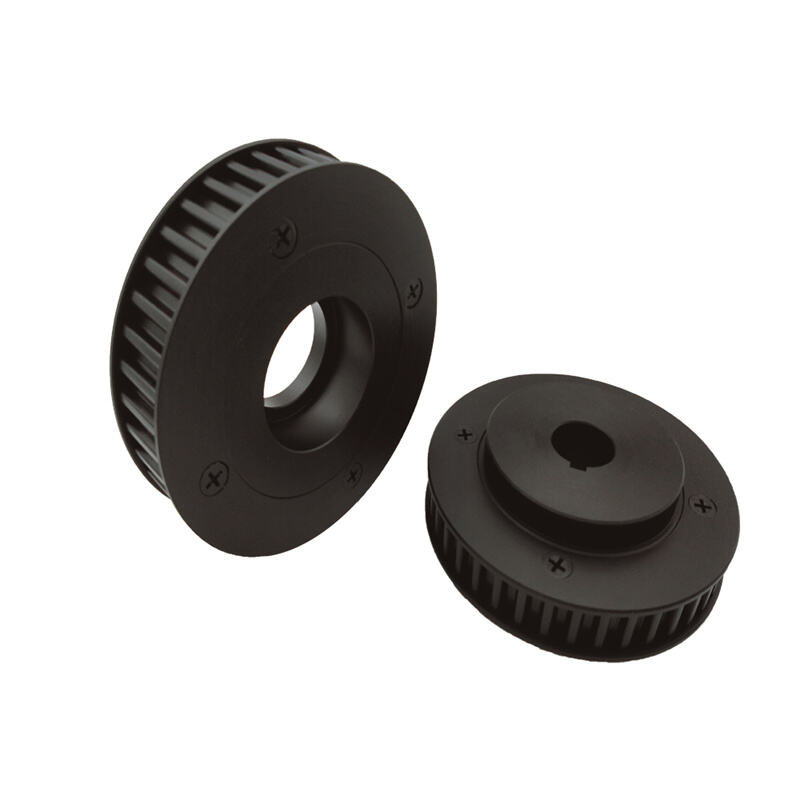
T10 profile aluminium timing pulley
Published AISI 1045 / C45 properties:
| Property | Value |
| Tensile strength | 570 to 700 MPa |
| Hardness | 170 to 210 HB |
Roughly twice the tensile strength of 6061-T6 and about twice the hardness before any surface treatment. The published rationale from pulley manufacturers is straightforward: strength and hardness higher than aluminium, heavier body, suited to high load and high speed.
The weight is not always a drawback. On a driven pulley, added inertia smooths speed variation. On a servo axis where you are trying to minimise reflected inertia, it is a real cost.
Choose steel when:
· Torque is high enough to deform aluminium teeth
· The drive runs continuously at speed with an abrasive belt
· The pulley is small, so tooth loads concentrate on few teeth
· Service temperature exceeds what aluminium tolerates
Polymer pulleys are used in light duty, food handling and applications where noise or weight matters. PA6 (nylon 6) is the common one.
Published PA6 data from an engineering polymer datasheet:
| Property | Value |
| Tensile strength | 79 MPa |
| Long term service temperature | 100 °C |
| Short term service temperature | 160 °C |
| Water absorption, 24 h | 0.3% |
| Water absorption, 96 h | 0.6% |
The tensile strength looks respectable at a quarter of 6061. The problem is the last two rows.
Nylon absorbs water and grows. A pulley machined to tolerance in a dry workshop and installed in a humid plant, or a washdown environment, changes dimension. On a timing pulley that means the pitch diameter changes and the tooth engagement changes with it.
Manufacturer documentation is explicit about this being a design consideration rather than a defect. It is inherent to the polymer.
Where plastic pulleys work well:
· Light loads, low speeds
· Noise sensitive applications
· Corrosive environments where metal would fail faster
· Applications where the pulley is deliberately the sacrificial part
Where they do not:
· Precision positioning, because dimensional drift defeats the point
· High torque, because the teeth shear
· Hot environments near the 100 °C continuous limit
We should be clear about a limitation in the published data we could verify: saturation moisture content and the resulting percentage dimensional change were not obtainable from a primary datasheet. The 24 and 96 hour absorption figures above are real; the long term equilibrium behaviour in a specific environment should come from your material supplier for the exact grade.
Cast iron appears in larger pulleys, with grades such as HT150, HT200, HT250 and GG25 named by manufacturers. The threshold where cast iron replaces aluminium is a size and cost question rather than a published rule, and we could not verify a specific diameter cutoff. In practice it is driven by casting economics: above a certain diameter, casting beats machining from billet.
Stainless pulleys use designations such as SUS303, SUS304 and AISI 431. The application is washdown, where the requirement is corrosion resistance rather than mechanical performance. Note that 303 and 304 are austenitic and cannot be hardened by heat treatment, so a stainless pulley is not a hard pulley.
| Requirement | Material |
| General industrial, moderate load | 6061-T6, plain or Type II anodised |
| Abrasive belt, continuous duty | 6061-T6 with Type III hardcoat, dimensions corrected for growth |
| High torque or high speed | C45 / 1045 steel |
| Minimum inertia on a servo axis | Aluminium, accept the wear |
| Washdown, food contact | Stainless |
| Light duty, quiet, low cost | PA6, accept dimensional drift |
| Large diameter | Cast iron |
Will hardcoat anodising make my aluminium pulley as hard as steel?
The surface layer at 400 to 700 HV is harder than 1045 steel at 170 to 210 HB. The substrate underneath is still soft aluminium, so the pulley resists abrasion but not deformation under heavy tooth loads.
Why did my anodised pulley not fit the belt properly?
Most likely the tooth form was machined to nominal and the coating growth closed up the tooth spaces. Check whether the drawing dimensions were specified before or after anodising.
Can I use a nylon pulley in a washdown application?
It resists corrosion, but it absorbs water and moves dimensionally. For washdown with precision requirements, stainless is the better answer.
Is 7075 better than 6061 for pulleys?
It is stronger, but it is also more expensive and less corrosion resistant. For most pulley duty the limit is surface wear rather than bulk strength, so hardcoating 6061 usually beats upgrading the alloy.
What temperature can an aluminium pulley handle?
6061-T6 has a maximum mechanical service temperature of 170 °C. In practice the belt is usually the limiting component well before the pulley.
Do steel pulleys need surface treatment?
For corrosion protection, often yes, depending on the environment. For wear, 1045 at 170 to 210 HB is generally adequate against standard belts without further hardening.
Tianjin HaoRongShengYe Electrical Equipment Co., Ltd. machines timing pulleys in aluminium, C45 steel, cast iron and stainless, in HTD, GT, T, AT and imperial profiles. If you are ordering hard anodised pulleys, tell us whether your tooth dimensions are before or after coating and we will set the toolpath accordingly.
