 EN
EN

A customer specifies a worm gearbox for a lifting application because worm drives are self-locking, so the load cannot run back down. No brake needed, cost saved.
This reasoning appears in a lot of machine designs, and it is dangerous enough that it appears as an explicit warning in an AGMA technical paper:
Note: Worm gear sets should not be considered self-locking. Under certain load conditions, worm wheel movement in reverse is possible.
An established engineering reference puts it more bluntly, naming the application:
In practice a worm should not be used as a braking device for safety linked systems e.g. hoists. Some material and operating conditions can result in a wormgear backsliding.
If you are designing a hoist, a lift, a gate, or anything where a dropping load injures someone, you need a brake. The worm geometry is not a substitute.
Here is the engineering behind that.
Self-locking depends on the relationship between the worm lead angle and the friction angle. Published statements of the rule, from three independent sources:
· Self-locking occurs when the worm lead angle equals arctan(friction coefficient), typically in the 2 to 8 degree range
· When the lead angle is less than the friction angle, the worm wheel cannot drive the worm in reverse
· The condition is: lead angle < arctan(coefficient of friction)
All three say the same thing in different notation. Below a certain lead angle, the drive resists back-driving.
The criterion uses a friction coefficient. Which friction coefficient?
At zero sliding velocity, the published figure is 0.15. That is the static value, and it is the highest value. As soon as sliding begins, the friction coefficient falls.
One reference notes that the static coefficient is the relevant one for the self-locking limit, precisely because the gear cannot be started.
This is the mechanism behind the failures. At rest, friction is high and the drive holds. Introduce vibration, and the drive experiences micro-motion. Micro-motion moves the contact from the static condition toward the dynamic condition, where friction is lower. The friction angle available to hold the load shrinks, and the load begins to creep.
Vibration is not an exotic condition. A machine running nearby, a motor starting on the same frame, a vehicle passing outside the building. All of it can defeat static self-locking.
No quantified vibration derating factor exists in the published literature we could find. That absence is itself informative: the engineering answer is not to derate self-locking, it is not to rely on it.
Self-locking and efficiency are two views of the same geometry. A drive that resists back-driving is a drive that wastes a lot of energy going forward.
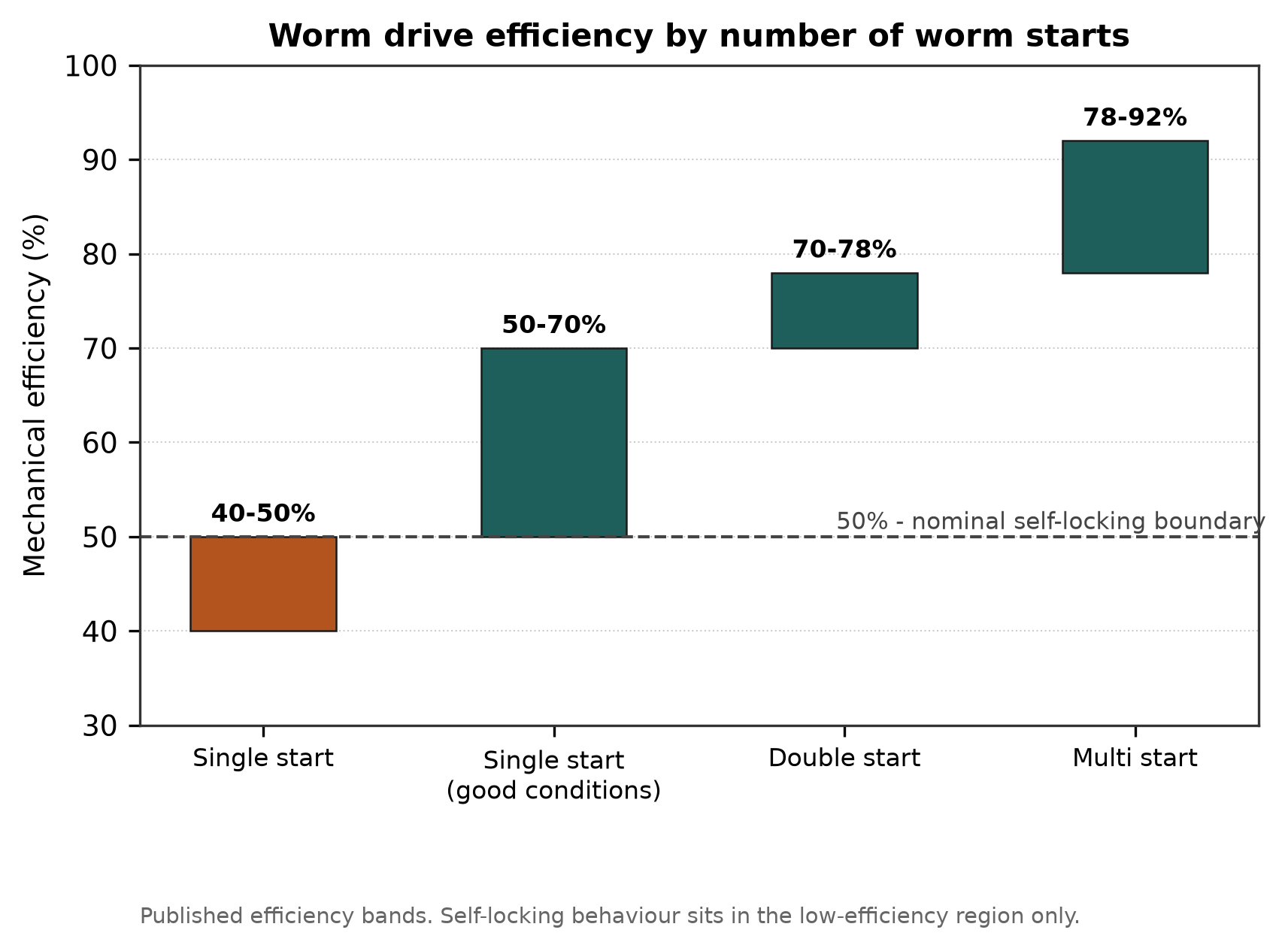
Worm drive efficiency by start count. Self-locking behaviour exists only in the low efficiency region.
The governing formula:
η = tan(λ) / tan(λ + φ)
where λ is the worm lead angle and φ is the equivalent friction angle.
A published worked example: for a single-start worm with λ = 5 degrees and φ = 6 degrees, efficiency is 45.01%.
Efficiency by number of worm starts:
| Worm type | Published efficiency |
| Single start | 40 to 50% |
| Single start, good conditions and high machining accuracy | 50 to 70% |
| Double start | 70 to 78% |
| Multi start | 78 to 92% |
For high efficiency designs, the recommended lead angle is 10 to 20 degrees. Note that this is well above the 2 to 8 degree self-locking band. You cannot have both.
One reference gives the overall span as 98% efficiency at the lowest ratios down to 20% at the highest. Another states 50 to 90% depending on lead angle, start count and friction.
The trade-off is unavoidable: self-locking costs you more than half your input power.
If you need self-locking behaviour:
· Accept single start, low lead angle, 40 to 50% efficiency
· Size the motor for the losses, not just the load
· Size the gearbox for the heat, because the lost power becomes heat
· Still fit a brake if the consequence of back-driving is injury or damage
If you need efficiency:
· Multi start, 10 to 20 degree lead angle, 78 to 92%
· Accept that the drive will back-drive
· Fit a brake, a counterweight, or use a different gear type
If you need both, worm gearing is the wrong choice. Consider a helical or bevel-helical unit with a proper holding brake.
Worm boxes are usually thermally limited rather than mechanically limited. The gear teeth could carry more torque than the box can dissipate as heat.
This is a direct consequence of the efficiency figures above. A single start worm drive at 45% efficiency converts more than half its input power into heat in a small housing. That is why worm gearbox catalogues list a thermal rating separately from the mechanical rating, and why the thermal rating is frequently the binding constraint.
Practical consequences:
· Continuous duty ratings are much lower than intermittent ratings
· Ambient temperature matters; a box rated in a 20 degree workshop behaves differently in a 40 degree plant room
· Forced cooling or a larger box is often cheaper than dealing with premature failure
Single reduction worm gearing covers 5:1 to 75:1 according to one reference, with another quoting 5:1 to 300:1 for worm gears used specifically for large reductions.
The high ratio capability in a single stage is the genuine advantage of worm gearing, along with the right angle layout and the quiet running that comes from the sliding contact. Those are the reasons to choose it. Self-locking should not be on the list.
For a standard 20 degree normal pressure angle, the lead angle should stay below 25 degrees.
Worm wheels run bronze against a hardened steel worm. The reason is the sliding contact: worm gearing slides rather than rolls, so the pair needs dissimilar materials with good sliding and embedding characteristics. Bronze against steel is the combination that works.
The worm is hardened and ground; the wheel is the sacrificial component. This is deliberate. When the drive wears out you replace the cheaper, easier part.
Pitch line velocity can reach 30 m/s in ideal conditions, but most industrial worm drives run far below this.
Can I use a worm gearbox to hold a load without a brake?
Not where a dropping load causes harm. Published guidance from AGMA and established engineering references explicitly says worm sets should not be considered self-locking, and specifically warns against using them as braking devices in hoists.
My worm gearbox has held a load for years without slipping. Is it not self-locking?
It is statically self-locking under its current conditions. Change the lubricant, let the gear wear, add vibration from new equipment, or increase the load, and that can change. Self-locking is a condition, not a property.
Why is my worm gearbox running so hot?
Because worm drives are inefficient and the lost power becomes heat. Check whether you are within the thermal rating rather than the mechanical rating; they are different numbers and the thermal one usually binds first.
Would a double start worm solve my efficiency problem?
It would raise efficiency from the 40 to 50% band into the 70 to 78% band. It also removes any self-locking behaviour. Make sure nothing in the machine depends on that.
What efficiency should I use for motor sizing?
Use the figure for your specific ratio and start count from the gearbox manufacturer's data, not a generic value. The range across worm designs is wide enough that a generic assumption will mis-size the motor.
Is bronze the only option for the worm wheel?
It is the standard for good reason, but the specific bronze varies with duty. Specify the grade with your gearbox supplier based on load, speed and duty cycle.
Tianjin HaoRongShengYe Electrical Equipment Co., Ltd. manufactures worm and worm wheel sets, bronze wheel against hardened ground steel worm, in single and multi start configurations. Tell us the ratio, the duty cycle and whether the drive must resist back-driving, and we will tell you honestly whether worm gearing is the right choice for your load.
