 EN
EN

Agricultural chain has its own numbering system, and it does not work the way ANSI chain numbering works. The number does not encode the pitch. Two chains numbered 550 and 620 have different pitches, different sprocket series, and are not interchangeable in either direction.
This catches people every season. Here is the system, with real dimensions.
The letter prefix tells you the intended duty:
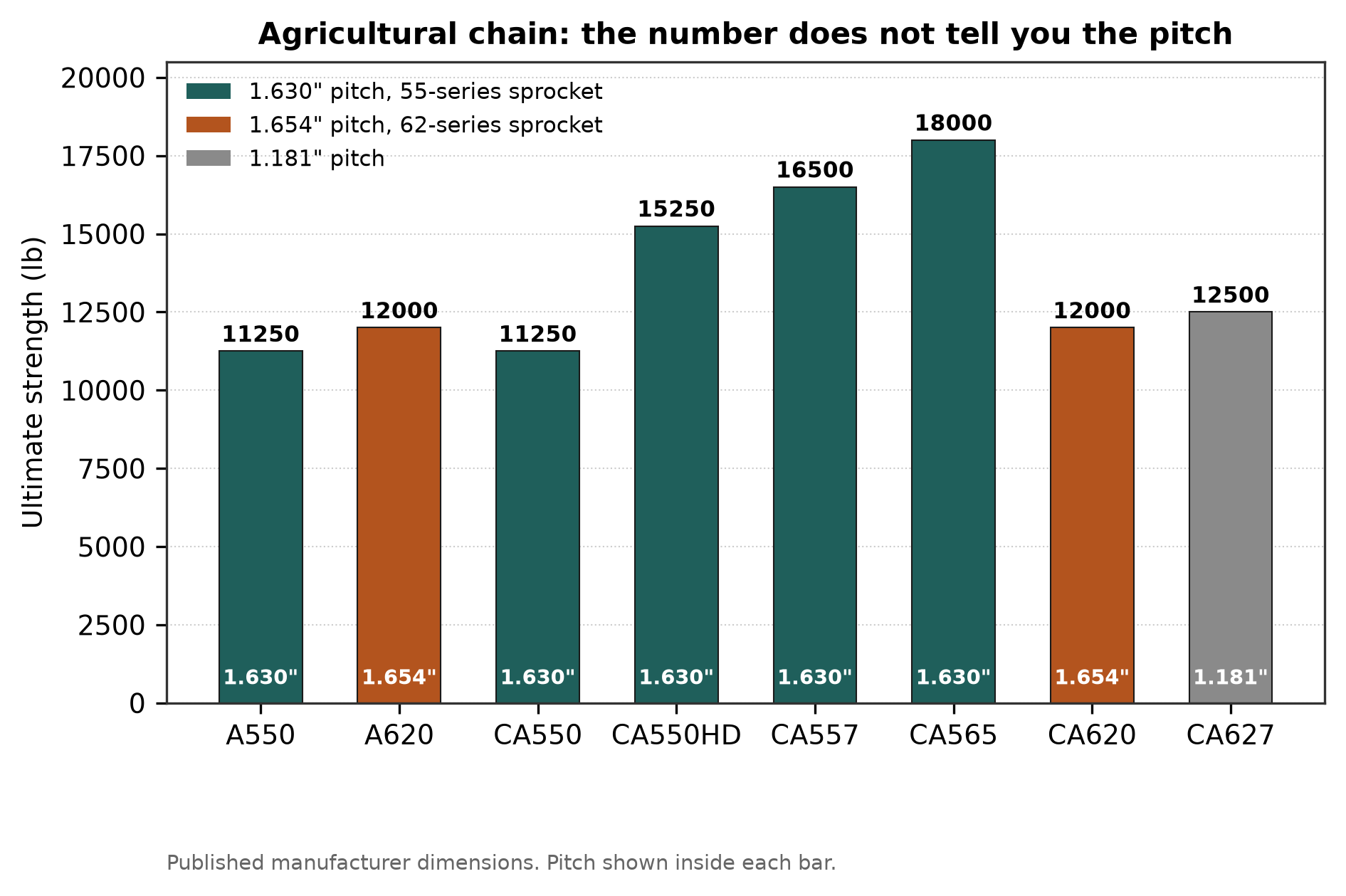
Agricultural chain strength and pitch. The designation number maps to a sprocket series, not a pitch.
· A-series (A550, A555, A557, A620) — drive chains
· CA-series (CA550, CA550HD, CA555, CA557, CA565, CA620, CA627) — conveyor chains
Both are built from hardened steel to close tolerances for combines, forage harvesters and similar machinery. The distinction is duty, not construction quality.
Published dimensions and strengths:
| Chain No. | Series | Pitch (in) | Roller dia (in) | Plate height (in) | Plate thickness (in) | Ultimate strength (lb) |
| A550 | Drive | 1.630 | 0.656 | 0.750 | 0.105 | 11,250 |
| A555 | Drive | 1.630 | 0.656 | 0.750 | 0.125 | 11,250 |
| A557 | Drive | 1.630 | 0.700 | 0.906 | 0.125 | 16,500 |
| A620 | Drive | 1.654 | 0.696 | 0.750 | 0.125 | 12,000 |
| CA550 | Conveyor | 1.630 | 0.656 | 0.750 | 0.105 | 11,250 |
| CA550HD | Conveyor | 1.630 | 0.656 | 0.813 | 0.120 | 15,250 |
| CA555 | Conveyor | 1.630 | 0.656 | 0.750 | 0.125 | 11,250 |
| CA557 | Conveyor | 1.630 | 0.700 | 0.906 | 0.125 | 16,500 |
| CA565 | Conveyor | 1.630 | 0.698 | 1.000 | 0.178 | 18,000 |
| CA620 | Conveyor | 1.654 | 0.696 | 0.750 | 0.125 | 12,000 |
| CA627 | Conveyor | 1.181 | 0.625 | 0.813 | 0.118 | 12,500 |
Notice CA627. Its pitch is 1.181 inches, completely different from the 1.630 and 1.654 of the rest. The numbering system does not warn you.
In metric, CA620 measures 42.01 mm pitch, 17.91 mm roller diameter, 24.51 mm between inner plates, with an average tensile strength quoted as 55.10 kN by one maker.
This is the part that causes wrong orders:
· 55-series sprockets for A550, A555, A557, CA550, CA550HD, CA555, CA557
· 62-series sprockets for A620, CA620, CA650
The numeric part of the chain designation maps to a sprocket series, not to a pitch. A550 and A620 have different pitches (1.630 vs 1.654 in) and take different sprockets. The 24 thousandths of an inch difference in pitch is enough to destroy both chain and sprocket over a season.
When ordering, quote both the chain number and the sprocket series. If a supplier offers you "550 chain" without specifying A or CA, ask which.
Agricultural drives run slowly and take a beating. The design response is heavy sections rather than high speed capability.
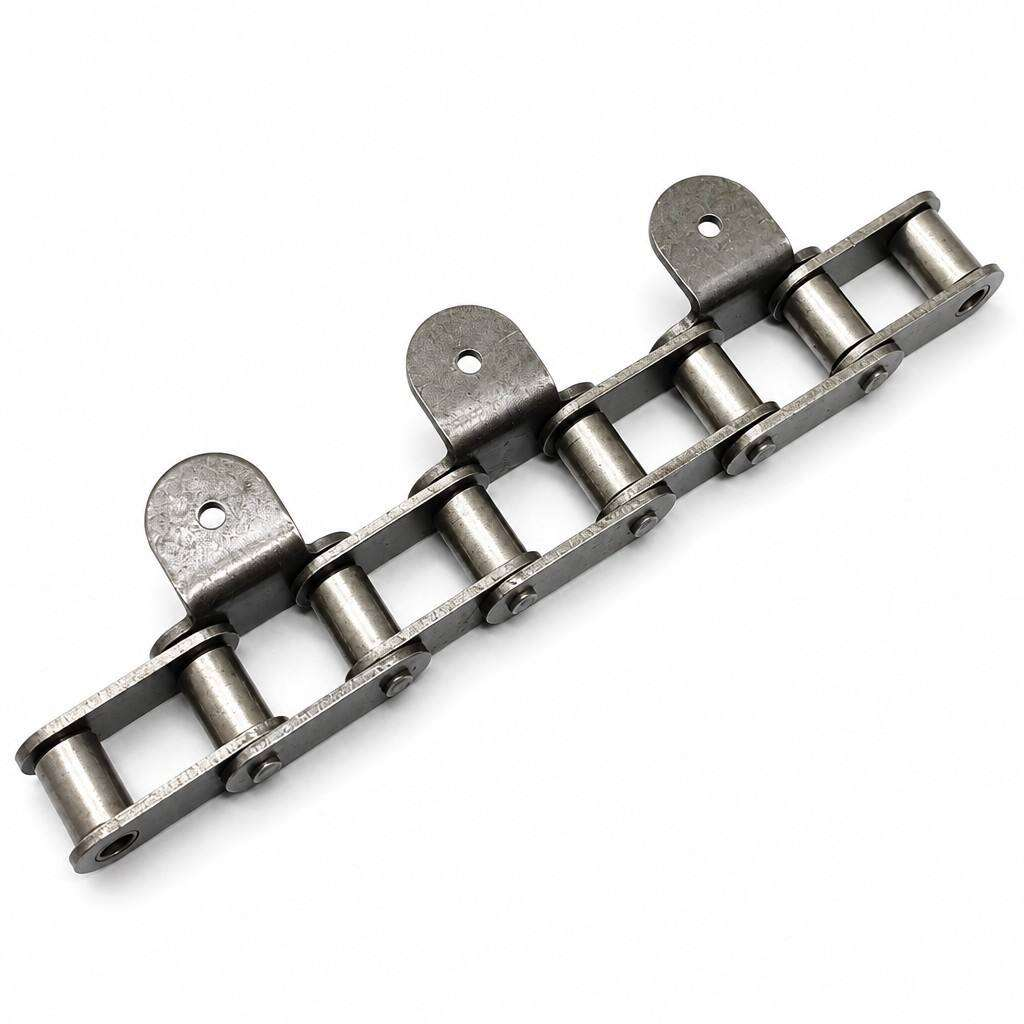
Agricultural attachment chain
Published manufacturing treatments for CA-series chain:
· Heat treated for added strength
· Shot peened for increased fatigue resistance
· Pre-stretched to eliminate initial elongation
Pre-stretching matters more than it sounds. New chain normally beds in with an initial elongation that is not wear; on a harvester where you cannot retension mid-season, pre-stretched chain avoids the early slack that would otherwise cause the chain to climb the sprocket teeth.
Shot peening addresses fatigue from shock loading. Ground engaging equipment delivers impact loads continuously, and fatigue cracking at the plate holes is a real failure mode in this service.
ISO 487:1998 covers steel roller chains of types S and C. Its scope, verbatim:
This International Standard specifies the characteristics of a range of steel roller chains, dimensionally derived from the malleable iron type and suitable for the conditions of operation and maintenance prevailing in such fields as agriculture, building, quarrying and related industry, mechanical handling, etc.
"Dimensionally derived from the malleable iron type" is the key phrase. These chains inherit their geometry from cast malleable chain that predates roller chain, which is precisely why the dimensions do not follow the ANSI logic.
Double pitch agricultural power transmission chain is built to ASME/ANSI B29.3, a separate standard from the B29.1 that governs standard roller chain.
Still in use, and still sold, for hay elevators and firewood conveyors. Sizes 55 and 62 are the common ones, matching the same numeric families as the roller chain above.
Detachable chain trades strength and smoothness for field repairability. A link can be replaced with hand tools in a field. That still matters when a breakdown means losing a harvest window.
Agricultural service attacks chain in ways industrial service does not:
Fertiliser is aggressively corrosive, particularly ammonium nitrate and potash dust. Silage acids are worse. Soil abrasion grinds away at pin and bush surfaces whenever dirt enters the joint.
Protection options, in rough order of cost:
· Zinc plating — light corrosion protection, sacrificial, wears off at the joint
· Nickel plating — better corrosion resistance, harder surface
· Dacromet and similar coatings — good salt resistance
· Stainless — for corrosive service, but see the strength penalty; stainless is explicitly not recommended for heavy duty agricultural power transmission because load capacity per pitch is the whole point
For most agricultural drives, plated carbon steel is the right answer. Stainless is for food handling downstream of the field, not for the harvester.
Work through it in this order:
1. Drive or conveyor? A-series or CA-series.
2. What sprockets are already on the machine? 55-series or 62-series. This usually decides the chain family before anything else.
3. What ultimate strength do you need? Apply a service factor for shock loading; agricultural equipment sees heavy shock and the factor should reflect it.
4. What attachments? Conveyor chain usually needs attachments; confirm the type and spacing.
5. Corrosion exposure? Fertiliser and silage push you towards plating.
If you are replacing chain on existing machinery, measure the pitch over several links rather than trusting the number stamped on the old chain. Chains get substituted during previous repairs, and the sprockets tell you more than the chain does.
Can I fit CA620 chain on 55-series sprockets?
No. CA620 takes 62-series sprockets. The pitch difference is small but it will destroy both parts.
What is the difference between A550 and CA550?
Dimensionally they are the same: 1.630 in pitch, 0.656 in roller, 11,250 lb ultimate strength. A-series is designated for drive duty and CA-series for conveyor duty, which affects the attachments available rather than the base chain.
Why is CA550HD stronger than CA550?
Thicker plates (0.120 in vs 0.105 in) and a taller plate section (0.813 in vs 0.750 in), which lifts ultimate strength from 11,250 to 15,250 lb at the same pitch.
Different suppliers quote different strengths for CA620. Which is right?
Both, for their own product. Published figures range from 12,000 to 14,000 lb depending on maker and testing convention. Use the figure from the chain you are actually buying, and do not average across catalogues.
Do I need to pre-tension agricultural chain?
Follow the machine manufacturer's procedure. Pre-stretched chain reduces initial slack but the drive still needs correct tension at installation.
How much wear is acceptable?
Measure elongation against the same limits used for industrial chain, but check the machine manual, as some agricultural applications with limited take-up tolerate less.
Tianjin HaoRongShengYe Electrical Equipment Co., Ltd. manufactures agricultural chain in the A and CA series with attachments, plus the matching 55-series and 62-series sprockets. Quote us the chain number and the sprocket series together, or send a sample link, and we will confirm the pitch before anything ships.
