 EN
EN

A food plant engineer asks for #40 stainless chain to replace #40 carbon steel chain. Same pitch, same sprockets, drop-in swap. Then the line runs at reduced capacity for six months until the chain fails early and nobody understands why.
The reason is in the working load figures, and it is much bigger than most people expect.
Published working loads at matching ANSI sizes:
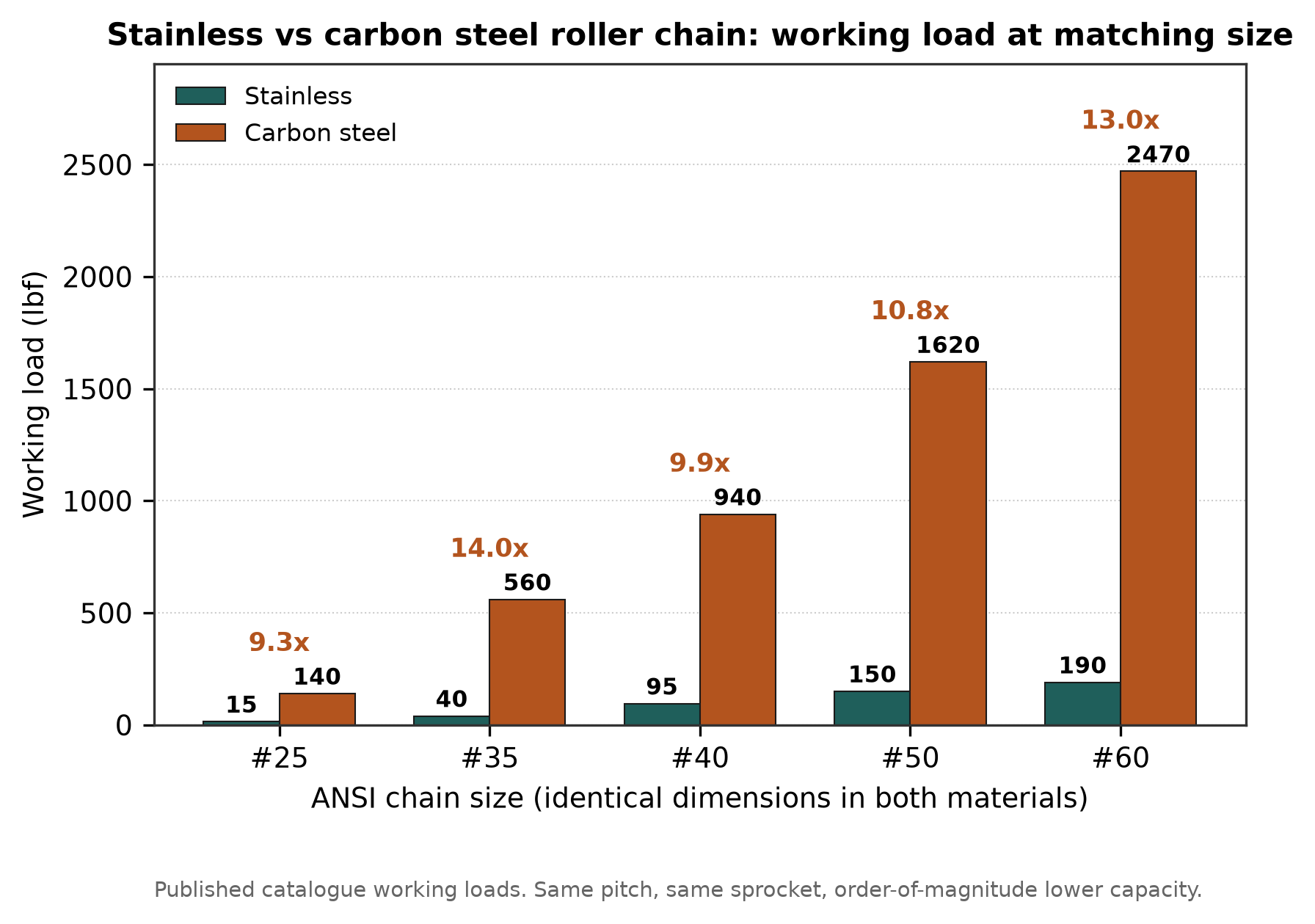
Stainless carries roughly one tenth the working load of carbon steel at the same ANSI size.
| ANSI No. | Pitch | Stainless working load | Carbon steel working load | Penalty |
| #25 | 0.250" | 15 lbf | 140 lbf | 9.3x |
| #35 | 0.375" | 40 lbf | 560 lbf | 14.0x |
| #40 | 0.500" | 95 lbf | 940 lbf | 9.9x |
| #50 | 0.625" | 150 lbf | 1,620 lbf | 10.8x |
| #60 | 0.750" | 190 to 230 lbf | 2,470 lbf | 13.0x |
A #40 stainless chain carries 95 lbf where the carbon steel equivalent carries 940 lbf. That is not a small derate. It is an order of magnitude.
The dimensions are identical, which is exactly what makes this dangerous. A #40 stainless chain runs on a #40 sprocket, fits the same guards, measures the same with the same tools. Nothing warns you except the catalogue.
One manufacturer answers the question directly on their FAQ page, asked whether carbon steel chain can be replaced with stainless:
No. 304 & 316 stainless steel is naturally a soft material and the max working loads are significantly lower than carbon steel chains.
Two mechanisms, both metallurgical.
Austenitic stainless cannot be hardened by heat treatment. Both 304 and 316 are solution annealed at 1010 to 1120 degrees C and rapidly cooled. There is no quench and temper step that raises surface hardness, because the alloy does not respond to one. Carbon steel chain components are hardened. Stainless components stay soft.
Lower base tensile strength. Even before hardening enters the picture, the stainless alloys used in chain have lower tensile strength than the carbon steels used in standard chain.
There is a third practical effect worth knowing: stainless retains more heat in service, which further affects tensile strength and wear life.
So the chain is softer at the pin and bush interface, where all chain wear happens, and it is weaker in the plates.
Once you have accepted the strength penalty, the grade choice is about chloride resistance.
The difference is molybdenum. 316 contains 2 to 3% Mo; 304 contains none. That single addition is what makes 316 resist pitting in chloride environments.
The standard way to quantify this is the Pitting Resistance Equivalent Number:
PREN = %Cr + 3.3 x %Mo + 16 x %N
304 has a PREN in the high teens. 316 lands meaningfully higher because of the molybdenum term. The higher the PREN, the better the alloy resists localised pitting attack.
Where this matters in a food plant:
· Brine, curing, pickling — 316, no argument
· Seafood processing — 316, chlorides are everywhere
· Chlorinated washdown water — 316 if concentrations are significant
· Bakery, dry goods, general food handling — 304 is usually sufficient
· Dairy — depends on the cleaning chemistry; check the caustic and acid cycle
PREN predicts pitting resistance. It does not predict stress corrosion cracking, crevice corrosion in tight geometry, or behaviour in strong acids. Treat it as a ranking tool, not a guarantee.
If the load exceeds what stainless can carry at the size you need, the answer is often not a bigger stainless chain.
Nickel plated or zinc plated carbon steel chain recovers most of the working load while still resisting light corrosion, at lower cost than stainless. For applications where the requirement is corrosion resistance rather than food contact compliance, this is frequently the better engineering answer.
Where it does not work: direct food contact, aggressive washdown with caustics, and anywhere the plating can chip and contaminate product. Plating is a coating; stainless is corrosion resistant through the section.
Published guidance names these explicitly:
· Heavy duty power transmission — agricultural equipment, industrial gearboxes, high torque drives, where load capacity per pitch is the entire point
· High speed drives — most stainless chain, including hollow pin designs, is rated for lower maximum speeds than carbon steel because of the hardness difference
If a corrosion or contamination problem does not exist, carbon steel at 10x the working load per dollar is almost always the better specification.
Double pitch stainless is available and useful for slow conveying. Stainless double pitch equivalents of #40, #50, #60 and #80 carry 95, 150, 230 and 390 lbf respectively at pitches of 1.0", 1.25", 1.5" and 2.0".
Note that in stainless there is often no single pitch #80 or larger stocked at all. The #80 equivalent exists only as double pitch chain. If your design calls for heavy single pitch stainless, check availability before you commit.
Hollow pin stainless is stocked in #40, #50 and #60, with pin hole diameters of 0.157", 0.202" and 0.236". Interestingly the hollow pin #60 rates higher than standard #60 stainless, 230 lbf against 190 lbf, because the construction differs.
Material choice is only part of food compliance.
FDA 21 CFR 178.3570 covers lubricants with incidental food contact. This is the rule behind H1 lubricants. If chain lubricant can reach product, it must comply.
NSF H1 registration is the practical way lubricant compliance is demonstrated. Specify H1 lubricant for any chain above or adjacent to open product.
EC 1935/2004 is the EU framework regulation for materials in contact with food: materials must not transfer constituents to food in quantities that endanger health or change composition, taste or odour.
3-A Sanitary Standards cover equipment design for cleanability in dairy and food processing. They affect how the chain is guarded and supported more than the chain itself.
A point that catches people: passivation. Stainless resists corrosion because of a chromium oxide layer. Aggressive cleaning, and particularly contact with carbon steel tooling that leaves embedded iron, damages that layer. Chain that rusts in a food plant is usually contaminated stainless rather than the wrong grade.
The method is straightforward once you accept the derate:
1. Calculate the actual chain tension from torque and sprocket pitch diameter
2. Apply your service factor for shock loading
3. Compare against the stainless working load, not the carbon steel figure
4. If it does not fit, go up in pitch, add strands, or reconsider whether you need stainless
Going up a size or two is normal. A drive that needs #40 in carbon steel may need #60 or #80 in stainless, with the sprockets and guarding to match. Budget for that at the design stage rather than discovering it during commissioning.
Can I just use a bigger stainless chain?
Yes, and often you must. Check the working load table rather than assuming one size up is enough; the gap is large.
Is 316 stronger than 304?
No. They have similar mechanical properties in the annealed condition. 316 is more corrosion resistant, not stronger. Both carry the same strength penalty against carbon steel.
Why did my stainless chain rust?
Most likely iron contamination from carbon steel tooling or cleaning implements, which breaks down the passive layer. Repassivation may recover it. The other common cause is chloride attack on 304 where 316 was needed.
Can I run stainless chain on my existing sprockets?
Dimensionally yes, the ANSI dimensions are identical. Whether the drive can operate at the reduced working load is the real question.
What temperature range does stainless chain handle?
Wider than carbon steel at both ends, which is one of its genuine advantages. Take the specific figures from the chain manufacturer's data for your grade and construction.
Do I need H1 lubricant if the chain is below the product?
If there is any possibility of incidental contact, yes. Splash, drip and airborne mist all count. Most plants standardise on H1 throughout the food zone rather than managing two lubricants.
Tianjin HaoRongShengYe Electrical Equipment Co., Ltd. supplies 304 and 316 stainless roller chain and sprockets for food processing, alongside nickel and zinc plated carbon steel where the requirement is corrosion resistance rather than food contact compliance. Send us the actual chain tension and the washdown chemistry and we will size against the stainless working load, not the carbon steel figure.
