 EN
EN

Gate rack looks like the simplest product we make. It is a toothed bar with holes in it. But it sits inside a machine that has to pass a force test, and the standard that governs that test names the rack specifically as a hazard.
From the EN 12453 test guidance on sliding gates:
Draw in is a risk in the wheel area, around the toothed rack, and where the gate passes a stationary post on the motor side.
So the rack is not just a drive component. It is a listed pinch hazard, and that shapes what you should specify.
Every sliding gate rack we produce, and every competing product we have measured, is module 4. There is no meaningful M3 or M6 market in residential and light commercial gates.
That is convenient. It means rack choice is not about tooth size, it is about material, core construction and mounting.
Welded steel rack. Solid steel, teeth cut or rolled, welded to the gate frame. Strongest option, cheapest per metre, and the default for heavy industrial gates. No corrosion protection unless you paint it, and the weld process means you cannot easily reposition it.
Galvanized steel rack. Same steel core, zinc coated, bolted rather than welded. Slotted holes let the installer adjust engagement during fitting. This is the volume product for commercial gates.
Nylon rack with steel core. Polyamide teeth moulded over a steel reinforcing bar. Quieter, corrosion proof, lighter to handle. The published material for the mainstream product is PA6 with 30% fibreglass, and the steel core is what carries the tensile load along the rack length.
The nylon versus steel decision is usually framed as a noise question. It is really a load question with noise as a bonus.
Published gate weight ratings put nylon racks in the residential and light commercial band and steel racks above it. The steel core in a nylon rack stops the bar stretching; it does not make the teeth as strong as cut steel teeth.
Practical guidance:
| Gate weight | Sensible rack choice |
| Up to around 500 kg | Nylon with steel core, or galvanized steel |
| 500 to 1000 kg | Galvanized steel |
| Above 1000 kg | Welded or bolted steel, heavier section |
Take the exact figure from the rack datasheet rather than the band. Manufacturers rate their own products and the ratings differ.
Two things degrade nylon that do not affect steel: UV exposure over years of outdoor service, and temperature. Check the rated temperature range against your climate, particularly if you are installing somewhere with hard winters or sustained high summer temperatures.
The recommended gap between rack and pinion on a sliding gate is 1 to 2 mm.
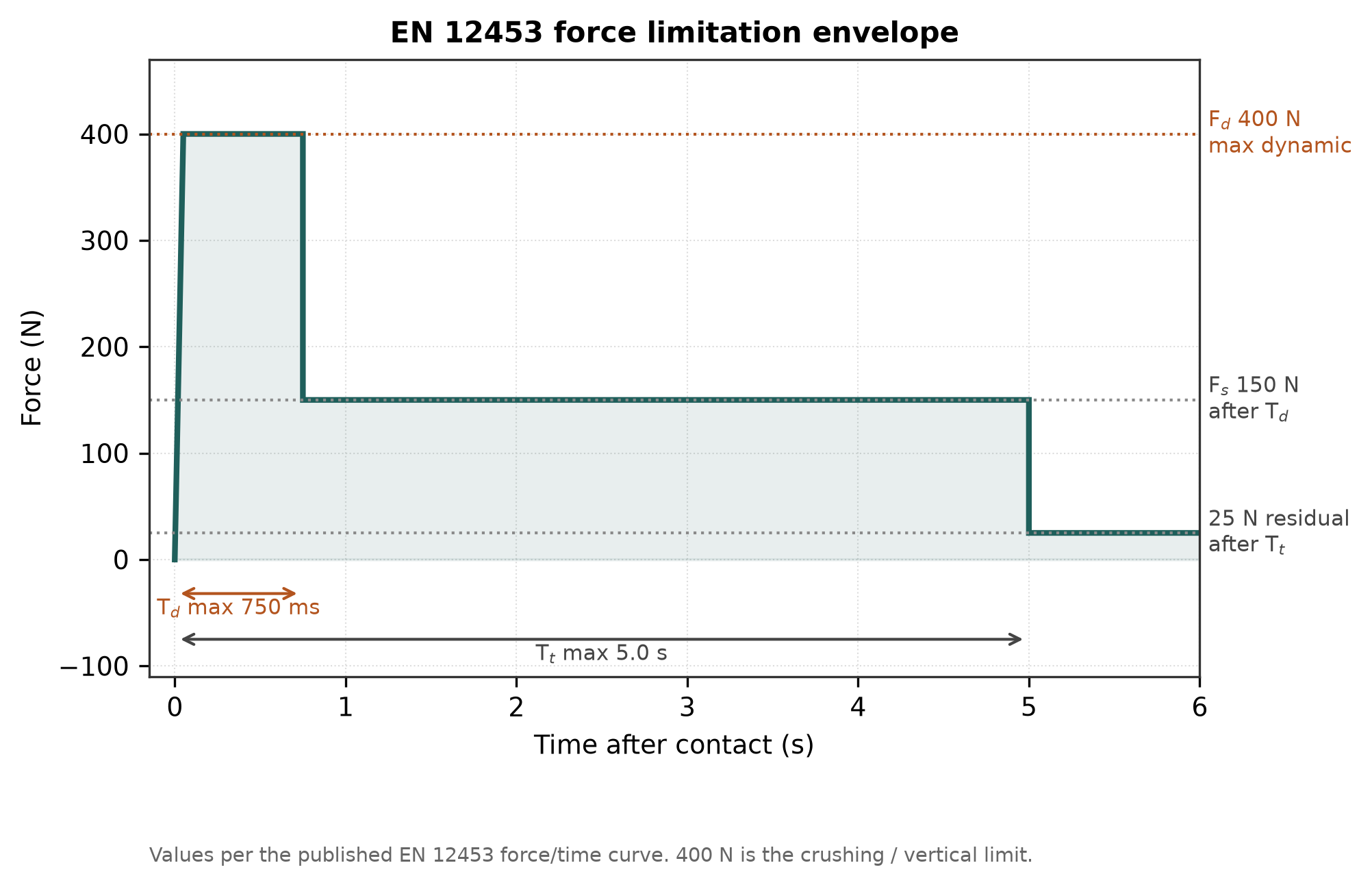
Figure 1. The EN 12453 force and time envelope that a powered gate must satisfy.
This is set at installation by the slotted mounting holes. Too tight and the motor works against the rack, drawing more current and wearing both parts. Too loose and the pinion skips under load, which is the failure mode that strands a gate half open.
The gap has to hold across the full travel, which means the rack sections must be aligned to each other and the gate must run level on its wheels. A gate that sags at one end will bind at that end regardless of how carefully you set the gap at the motor.
This is where gate installers get caught, because the numbers are specific and they are tested.
EN 12453 sets a force and time envelope. The measured force at a test point must follow this decay:
| Symbol | Meaning | Limit |
| F_d | Maximum dynamic force during T_d | 400 N |
| T_d | Time the force may exceed 150 N | max 750 ms |
| F_s | Maximum static force after T_d | 150 N |
| T_t | Time the force may exceed 25 N | max 5.0 s |
| Residual | Force after T_t | 25 N |
The standard's own summary sentence:
The dynamic force shall not exceed 400 N and the static force shall not exceed 150 N after T_d and 25 N after the total time T_t.
The 400 N versus 1400 N confusion. Both numbers are real and they describe different cases. 400 N is the limit for crushing, and for vertical movement such as a barrier boom. 1400 N is the permitted peak impact at first contact on a horizontal movement, and it only stays legal because the curve then forces the force down below 150 N within 750 ms and below 25 N within 5 s.
So a sliding gate may briefly register a high impact figure at first contact, but if it does not decay on schedule it fails.
Where the force is measured (per EN 12445, the test method standard):
· Three heights: 50 mm above ground, half the gate height, and 300 mm from the top of the gate or 2200 mm above ground, whichever is greater
· At gap widths of 50 mm, 500 mm and 1500 mm, or maximum gap width
· In crush zones, at 50 mm, 300 mm and 500 mm gaps
· Every measurement taken three times and averaged, with all readings recorded
Manual operation has its own limits: a barrier must be openable by hand with no more than 150 N in private areas, 260 N in industrial or commercial areas.
The US route is different. UL 325 classifies gate operators:
· Class I — residential, single family
· Class II — commercial, general public access
· Class III — industrial, limited access, general public not admitted
· Class IV — restricted, guarded access
The 2016 revision made external entrapment protection mandatory. An operator relying only on internal force sensing no longer complies; you need photo eyes or edge sensors as independent protection. ASTM F2200 covers the gate construction requirements that go alongside.
If you export gate hardware to both markets, these are genuinely different compliance paths and a product designed for one does not automatically satisfy the other.
A rack that meshes badly increases the force the motor must apply, and force test failures often trace back to mechanical drag rather than controller settings.
Three specific links:
1. Excessive backlash causes impact loading at each tooth. The motor sees a varying load and the controller's force sensing becomes less predictable.
2. Misaligned rack sections create tight spots. The gate moves freely for most of its travel then binds, and the binding point is where the force test fails.
3. Worn nylon teeth at the drive end increase drag progressively. A gate that passed on commissioning can fail two years later with no change to the controller.
If you are chasing a force test failure, measure the current draw across the full travel before adjusting the controller. A spike at a specific position is mechanical.
Is nylon rack strong enough for a 900 kg gate?
Usually not for continuous commercial duty. Check the specific product rating, but at that weight galvanized steel is the safer specification.
Why does my nylon rack wear faster at one end?
Almost always because the gate is not level or the rack is not parallel to the travel. The pinion loads one part of the tooth face. Check the gate wheels and the rack alignment before replacing the rack.
Can I mix steel and nylon rack sections on one gate?
Mechanically it will mesh, but the two materials wear at different rates and the joint between them becomes a step. Not recommended.
Does the 1 to 2 mm gap apply to nylon as well as steel?
Yes. The gap requirement comes from the tooth geometry, not the material.
What torque should I use on the rack mounting bolts?
Follow the rack manufacturer's figure. Over-torquing a nylon rack crushes the polyamide around the fixing and lets the rack shift; this is a common installation error.
Does a quieter rack help me pass the force test?
No. Noise and force are unrelated measurements. A nylon rack may run quietly and still fail on force if the gate binds somewhere in its travel.
Tianjin HaoRongShengYe Electrical Equipment Co., Ltd. produces module 4 sliding gate racks in welded steel, galvanized steel and nylon with steel core, along with the matched pinions. Tell us the gate weight, the duty cycle and whether you are certifying to EN 13241 or UL 325, and we will recommend the construction rather than just quoting the cheapest bar.
