 EN
EN

Pintle chain gets specified by ultimate tensile strength because that is the number printed largest in most catalogues. It is the wrong number to design with, and the gap between it and the correct number is bigger than most people expect.
For 662 chain: ultimate tensile strength is around 9,560 to 11,200 lb depending on grade. Maximum recommended working load is 1,710 lb.
That is a ratio of roughly 6:1. If you size a manure spreader floor chain on the ultimate figure, you will be running at six times the intended load.
Published dimensions and loads for the common pintle chain sizes:
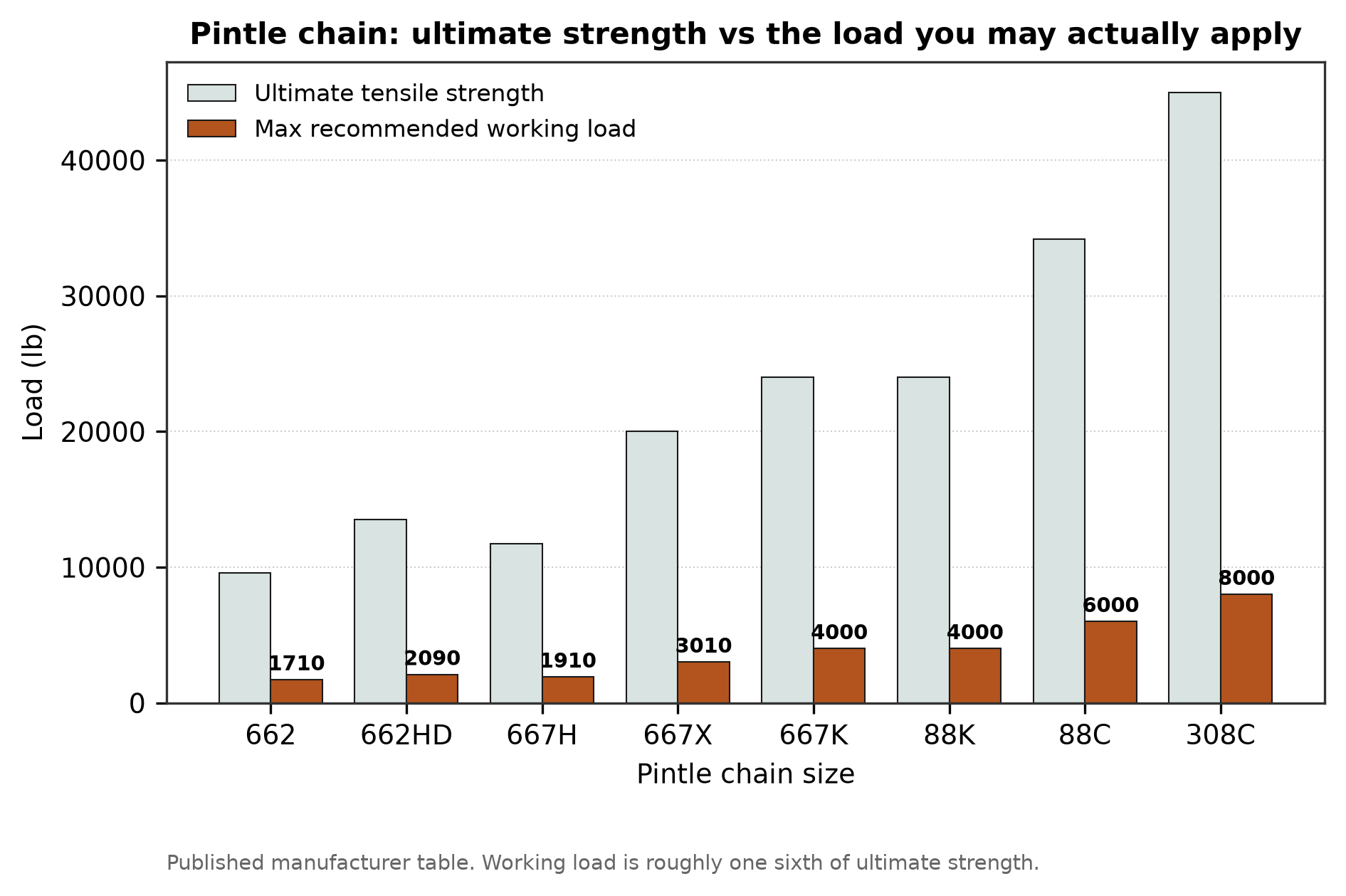
Ultimate tensile strength against maximum recommended working load.
| Chain | Pitch (mm / in) | Ultimate tensile (kN / lb) | Average tensile (kN / lb) | Max working load (kN / lb) | Inside width b1 | Pin dia | Plate height | Plate thickness |
| D205 | 31.75 / 1.25 | 18 / 4,050 | 21.8 / 4,900 | 2.5 / 560 | 9.53 mm | 5.08 mm | 11.9 mm | 2.1 mm |
| 662 | 42.27 / 1.664 | 42.5 / 9,560 | 49.8 / 11,200 | 7.6 / 1,710 | 23.2 mm | 7.16 mm | 18.3 mm | 3.20 mm |
| 662H | 42.27 / 1.664 | 48.9 / 11,000 | 52 / 11,700 | 7.8 / 1,755 | 23.2 mm | 7.16 mm | 20.4 mm | 3.6 mm |
| 662HD | 42.27 / 1.664 | 60 / 13,500 | 65.8 / 14,800 | 9.3 / 2,090 | 23.2 mm | 7.92 mm | 22.23 mm | 4.3 mm |
| 667H | 58.75 / 2.313 | 52.1 / 11,720 | 57.4 / 12,900 | 8.5 / 1,910 | 25.6 mm | 7.92 mm | 22.23 mm | 3.2 mm |
| 667J | 57.15 / 2.25 | 86.5 / 19,460 | 95 / 21,370 | 13.1 / 2,950 | 27 mm | 9.52 mm | 23.8 mm | 4.3 mm |
| 667X | 57.15 / 2.25 | 88.9 / 20,000 | 96.5 / 21,700 | 13.4 / 3,010 | 27 mm | 11.1 mm | 23.8 mm | 4.3 mm |
| 667K | 57.15 / 2.25 | 106.8 / 24,000 | 132 / 19,700 | 17.78 / 4,000 | 27.8 mm | 11.1 mm | 26.8 mm | 5.1 mm |
| 667XH | 57.15 / 2.25 | 124.5 / 28,000 | 138 / 31,050 | 21.4 / 4,810 | 27.8 mm | 11.91 mm | 26.8 mm | 5.7 mm |
| 667KC | 57.15 / 2.25 | 137.35 / 30,900 | 148 / 33,290 | 21.33 / 4,800 | 27.8 mm | 11.1 mm | 26.8 mm | 5.1 mm |
| 88K | 66.27 / 2.609 | 106.8 / 24,000 | 132 / 29,700 | 17.8 / 4,000 | 27.8 mm | 11.1 mm | 26.8 mm | 5.1 mm |
| 88C | 66.27 / 2.609 | 152 / 34,200 | 169 / 38,020 | 26.7 / 6,000 | 31.75 mm | 12.7 mm | 28.58 mm | 6.4 mm |
| 308C | 78.1 / 3.075 | 200 / 45,000 | 222 / 50,000 | 35.6 / 8,000 | 32.5 mm | 15.88 mm | 38.1 mm | 8 mm |
Design against the working load column. The others describe how the chain fails, not how it should be used.
Three pitch groups cover most of the market:
· 1.664 inch — 662, 662H, 662HD. Also matches CA620 and #62 chain
· 2.25 inch — 667X, 667XH, 667K, 667KC, 667J
· 2.609 inch — 88K, 88C
Note 667H is the odd one: its pitch is 2.313 inch, not 2.25 like the rest of the 667 family. Despite the shared 667 prefix it takes different sprockets. This is a recurring source of wrong orders.
Within a pitch group the variants differ by plate thickness and pin diameter. 662 at 3.20 mm plate and 662HD at 4.3 mm share the same pitch and inside width, so they run on the same sprockets, but the heavy version carries 2,090 lb working load against 1,710 lb.
That is the cheapest upgrade available in this product family: same sprockets, same installation, 22% more working load.
Pintle chain is cast or forged offset sidebar chain with an open barrel. It exists because roller chain fails quickly in dirty, abrasive service.
The published construction advantages:
· Open barrel design prevents material buildup in sprocket roots
· Detachable links can be removed and replaced individually with hand tools
· Offset sidebar configuration provides articulation and flexibility
· Quad-staked pins hold pins in place under load
The open barrel is the key feature. A roller chain running in manure, silage or salt packs the sprocket roots with material, which effectively increases the pitch diameter and makes the chain ride high on the teeth. Pintle chain sheds it.
The detachable construction matters for a different reason. When a chain breaks in a spreader mid-season, a field repair with spare links gets the machine running again in minutes. A roller chain break usually means pulling the whole chain.
Published application lists converge on:
· Manure spreader floor chains and beater chains
· Forage wagon aprons and cross conveyors
· Salt spreader aprons
· Feeder systems and hay handling equipment
· Spray boxes
· Industrial conveyors in dirty environments
The common thread is abrasive contamination rather than high speed or high precision. Pintle chain is explicitly described as suitable "in limited use" for power transmission, which is a polite way of saying do not use it as a drive chain if you have a choice.
1. Calculate the actual chain pull. For a floor conveyor this is the material weight times the friction coefficient of the slat on the trough, plus the chain's own weight on the return run.
2. Apply a service factor for shock loading. Spreaders and feeders deliver heavy shock; the load is not steady.
3. Compare against maximum recommended working load, not ultimate tensile strength.
4. Check the pitch against your existing sprockets before anything else if this is a replacement.
5. Decide on the grade within the pitch family. Going from 662 to 662H or 662HD buys working load without changing sprockets.
You will see different ultimate strengths quoted for the same chain number by different suppliers. One source lists 662 at 11,000 lb ultimate; the table above shows 9,560 lb ultimate and 11,200 lb average from a different manufacturer.
These are not errors. Manufacturers publish to different conventions, some quoting minimum ultimate and some average, and actual chain differs between makers. Use the figures from the chain you are buying, and do not average across catalogues.
One more oddity worth flagging: in the table above, 667K shows an average tensile strength of 19,700 lb against an ultimate of 24,000 lb, which is the reverse of the normal relationship. That is how it appears in the published source. Treat it as a reason to confirm with the supplier rather than as a datum.
Pintle chain is usually specified with attachments: slats, flights, buckets or brackets bolted to the chain. Attachment designations vary by manufacturer and the spacing is specified in pitches.
When ordering, state the chain number, the attachment type, and the attachment spacing in pitches. "662 chain with A2 attachments every 4th pitch" is an orderable specification. "662 chain with slats" is not.
Can I replace 667H with 667X?
No. 667H has a 2.313 inch pitch and 667X has 2.25 inch. Different sprockets. The shared 667 prefix is misleading.
Why is the working load only a sixth of the ultimate strength?
Because ultimate strength is the load at which the chain breaks in a single pull. Working load accounts for fatigue over millions of cycles, shock loading, wear and a safety margin. Designing to ultimate strength means designing for immediate failure.
Is pintle chain stronger than roller chain?
Not per unit weight. It is more tolerant of contamination and easier to repair in the field. For clean, high speed power transmission, roller chain is better on every metric.
Can I upgrade from 662 to 662HD without changing sprockets?
Yes. Same pitch, same inside width, thicker plates and a larger pin. Check clearances around the chain path, as the chain is physically bulkier.
What causes pintle chain to wear out fastest?
Abrasive material entering the pin and barrel joint. That is inherent to the application. Keeping the chain correctly tensioned so it does not whip, and clearing packed material from sprocket roots, extends life more than lubrication does in dirty service.
Do I need to lubricate pintle chain?
In clean service, yes. In heavily contaminated service, lubricant can trap abrasive material in the joint and make wear worse. Follow the equipment manufacturer's guidance for your specific application.
Tianjin HaoRongShengYe Electrical Equipment Co., Ltd. supplies steel pintle chain from D205 through 308C with attachments, plus the matching sprockets. Send us the conveyor pull and the duty rather than a chain number, and we will size against maximum recommended working load instead of ultimate tensile strength.
