 EN
EN

A woodworking CNC gantry is not a demanding drive by load standards. A 3 metre router pushing a cutter through MDF needs a fraction of what a plasma table or a construction hoist needs.
Yet rack and pinion on woodworking machinery wears out faster than on machines doing far heavier work. The reason has nothing to do with force.
MDF dust in particular is fine, hard, and everywhere. It contains cured resin as well as wood fibre, and the resin particles are harder than you would expect from a wood product.
When that dust lands on a lubricated rack, it does not blow away. It sticks to the grease, and the grease holds it against the tooth flank while the pinion rolls over it. The result is a lapping compound running between two steel surfaces under load, thousands of times per shift.
This inverts the normal lubrication advice. On a clean machine tool, more grease means less wear. On a woodworking machine, more grease can mean more wear, because the grease is what retains the abrasive.
Three approaches are used in practice:
Dry running. No lubricant at all, accepting higher steel-on-steel wear in exchange for not holding dust. Works on light duty machines with hardened racks. The rack will wear, but it wears predictably rather than being lapped.
Minimal lubrication with regular cleaning. A thin film, wiped and reapplied on a schedule. Effective but depends on the schedule actually being followed.
Automatic lubrication with a wiper. A felt or brush wiper ahead of the pinion clears dust, followed by a metered lubricant application. This is the right answer on production machinery and it is what the better panel processing lines use.
Whichever route, the mechanical requirement is the same: the rack needs to be accessible for cleaning. A rack buried in a channel where nobody can reach it will fill with compacted dust regardless of the lubrication strategy.
How the three approaches compare in practice:
| Approach | Wear mechanism | Suits | Weakness |
| Dry running | Steel on steel, predictable | Light duty, hardened racks, poor extraction | Higher baseline wear rate |
| Minimal lubrication + scheduled cleaning | Low, if the schedule holds | Small shops, one or two machines | Fails entirely when cleaning is skipped |
| Auto-lube with wiper ahead of pinion | Lowest | Production machinery, multi-shift | Highest capital cost, wiper needs replacing |
On a woodworking gantry, mount the rack with the teeth facing downward or sideways wherever the design allows. A rack with teeth facing up is a dust collection trough.
This sounds obvious and it is routinely ignored, because teeth-up is often the easiest mounting for the machine builder. The maintenance cost lands on the end user two years later.
Where teeth-up mounting is unavoidable, a bellows cover or a brush seal over the rack is worth the cost.
Woodworking does not need machine tool accuracy. Cutting tolerance on panel work is typically measured in tenths of a millimetre, not microns, and the material itself moves with humidity by more than the drive error.
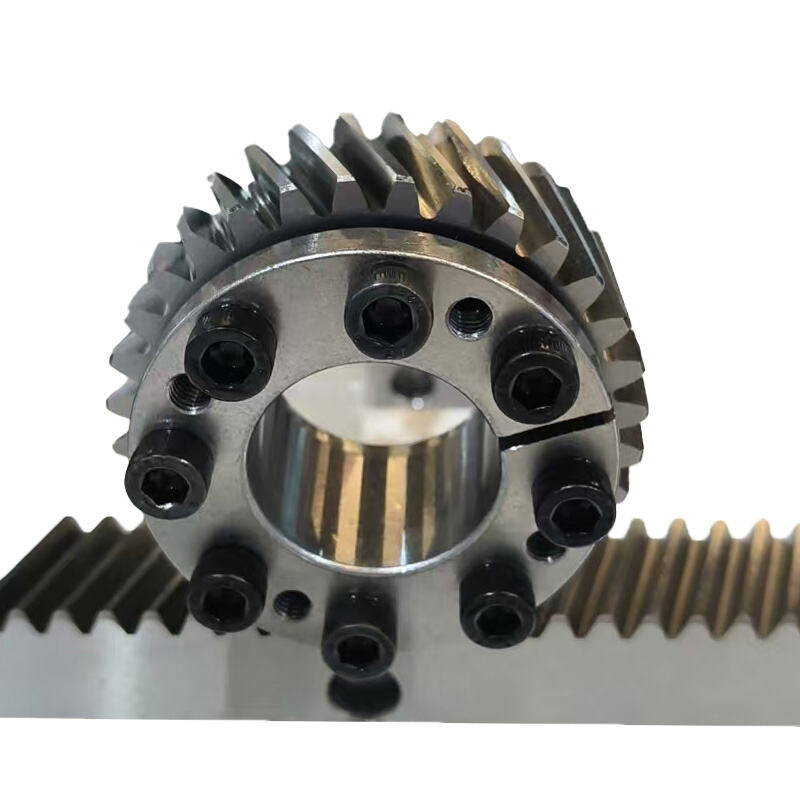
Module 2, 32 tooth ground gear for woodworking machinery
This matters commercially because it means you should not overspecify the rack quality class. A hardened and ground rack at a high DIN class costs several times a quality-milled rack, and on a panel router the difference disappears into the tool deflection and the material.
Where higher rack quality does earn its cost:
· Nested-based manufacturing with small parts, where cumulative error across a sheet matters
· Machines with long gantries where rack splice errors accumulate
· Five-axis and aggregate heads where positional error compounds through the head geometry
Where it does not:
· General panel cutting and drilling
· Machines where the spindle deflection under load exceeds the drive error anyway
We sell both. The honest answer is that most three-axis woodworking routers are well served by a mid-range rack quality, and the money is better spent on dust protection than on accuracy class.
Helical racks run more quietly and engage more smoothly, which matters in a workshop where the operator stands next to the machine all day.
The trade-off is axial thrust. A helical rack generates a force along the pinion axis proportional to the tangential force, and the pinion bearings have to carry it. On a machine designed for straight racks, retrofitting helical without checking the bearing arrangement causes premature bearing failure.
For new woodworking machine designs, helical is generally worth it. The noise reduction is real and the loads are modest enough that the thrust is manageable.
Woodworking machines often have long X axes, 3 to 6 metres being common on panel routers. That means spliced rack, and every splice is a potential pitch error.
Two practical points:
Fewer, longer sections beat many short ones. Each joint contributes error. Three 2-metre sections accumulate less error than twelve 500 mm sections.
Splices need proper alignment, not just bolting. The standard method uses a gauge pinion or a master rack section spanning the joint during tightening, so the tooth pitch continues correctly across the splice. Bolting two sections down to a nominally straight beam and hoping is how you get a machine that loses position at one specific point in its travel.
On a woodworking machine, the pinion usually wears before the rack, because every pinion tooth engages hundreds of times more often than any given rack tooth.
This is convenient. The pinion is the cheaper part and the easier one to replace. It also means replacing a worn pinion onto a worn rack is a mistake: the new pinion tooth profile does not match the worn rack profile, contact concentrates on a small area, and the new pinion wears rapidly.
If the rack is worn enough to show a visible step at the pitch line, replace both.
Practical specification for a woodworking CNC rack:
| Decision | Recommendation | Reason |
| Tooth hardening | Hardened teeth | Dust abrasion is the dominant wear mechanism |
| Quality class | Mid-range unless the application needs better | Material movement and tool deflection exceed drive error on most panel work |
| Tooth orientation | Facing down or sideways | Teeth-up mounting collects dust |
| Section length | Longest practical, fewest splices | Every joint contributes pitch error |
| Pinion source | Same supplier as the rack | Tooth forms must match |
| Profile | Helical on new designs | Quieter; check pinion bearings carry the axial thrust |
| Lubrication | Decided with the dust control strategy | Grease without dust control accelerates wear |
Should I grease the rack on my CNC router?
It depends on your dust control. With good extraction and a wiper system, light lubrication extends life. With poor dust control and no wiper, grease can accelerate wear by holding abrasive against the teeth. Many woodworking machines run dry deliberately.
My machine loses position at the same point every time. What is it?
Almost certainly a rack splice. Check the joint at that position in the travel; a pitch error at a splice produces exactly this symptom.
Is a hardened and ground rack worth it on a panel router?
Usually not for accuracy, but hardening is worth it for wear resistance in a dusty environment. You can specify hardened teeth without paying for post-hardening grinding.
How often should I replace the pinion?
When backlash becomes noticeable or the tooth flanks show visible wear steps. There is no universal hour figure; it depends entirely on dust exposure and lubrication practice.
Can I use the same rack as on a metalworking machine?
Mechanically yes. The specification priorities differ: metalworking favours accuracy class, woodworking favours surface hardness and dust tolerance.
Why does my rack wear unevenly along its length?
Because the machine spends most of its time in part of the travel. This is normal. It becomes a problem when the worn zone develops enough backlash to affect cut quality while the rest of the rack is fine; at that point the rack is scrap even though most of it is unworn.
Tianjin HaoRongShengYe Electrical Equipment Co., Ltd. manufactures gear racks and matched pinions for woodworking machinery, straight and helical, in quality classes from DIN 10 through DIN 5 with hardened teeth. Tell us the gantry length and your dust control arrangement and we will recommend a specification that survives the environment rather than one that looks good on paper.
