 EN
EN

A drive needs more capacity than a single chain can carry. The obvious answer is two chains side by side, or three. Twice the chain, twice the capacity.
It does not work that way, and the shortfall is published in every chain manufacturer's engineering data as the multiple strand factor.
Two strands give you less than twice the capacity. Three strands give you noticeably less than three times. The gap widens as you add strands.
Three mechanisms, all mechanical rather than metallurgical.
Load sharing is imperfect. The strands are connected by common pins, but they are not identical. Manufacturing tolerance means one strand is fractionally shorter or tighter than the other, and the tighter strand takes more load. Over the life of the drive the loads equalise as the tight strand wears faster, but at any instant the distribution is uneven.
Sprocket tooth alignment. A duplex sprocket is cut with both tooth rows in one operation, so alignment is good, but not perfect. Any angular error between the rows means one row engages slightly before the other.
Shaft deflection. A wider sprocket sits further from the bearing, or spans a wider portion of the shaft. Shaft deflection under load tilts the sprocket, which loads the outer strand more than the inner one. This is the mechanism that gets worse with more strands, because a triplex sprocket is wider than a duplex.
The method is straightforward once you know the factor exists:
1. Calculate the required chain pull
2. Divide by the multiple strand factor for the number of strands
3. Select a chain size whose rating meets the adjusted figure
The critical error is skipping step 2. A designer who needs three times the capacity of a single chain and specifies triplex will be running the drive above its rating from day one.
Take the multiple strand factors from your chain supplier's engineering data for the specific chain series. They vary slightly between manufacturers and chain types, and we would rather tell you to look them up than quote a figure we cannot source precisely.
Space constraint on sprocket diameter. If the drive must fit within a diameter that a larger single chain cannot achieve, multi-strand solves it. This is the most common legitimate reason.
Speed constraint. A larger pitch chain has more chordal action at a given tooth count. If the drive runs fast enough that a bigger pitch would cause vibration, adding strands at the smaller pitch keeps the polygon effect down.
Redundancy is not a reason. Multi-strand chains share pins; if a pin fails, the whole assembly fails. Two separate chains on separate sprockets give redundancy. A duplex chain does not.
Cost. Triplex chain and triplex sprockets cost more than a single chain one or two sizes up, in most size ranges.
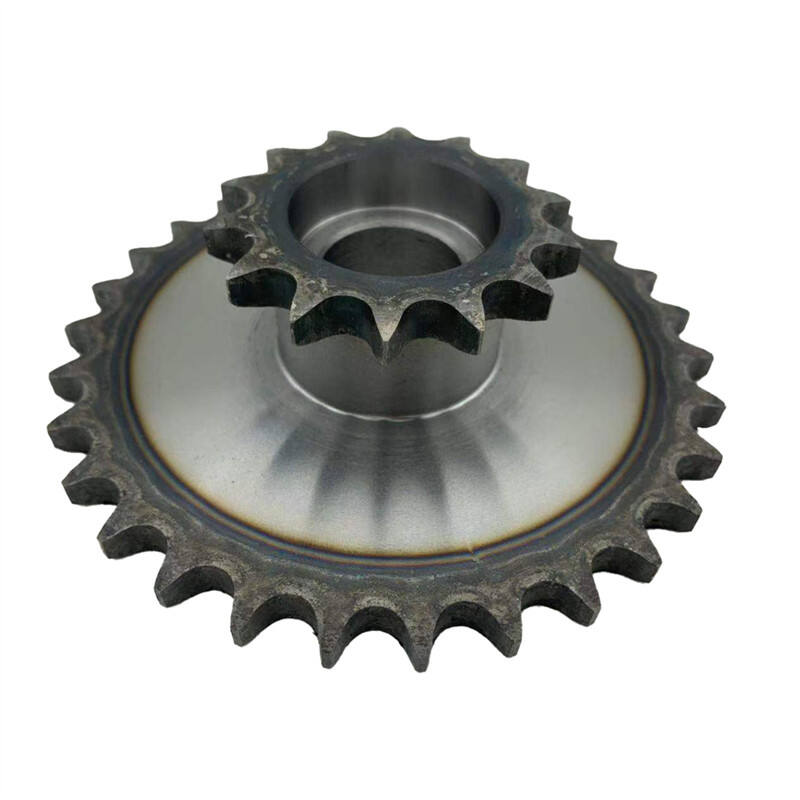
Double strand sprockets
Alignment sensitivity. A single chain tolerates a small amount of sprocket misalignment. Multi-strand is less forgiving, because misalignment directly worsens the load sharing that is already imperfect.
Maintenance. A multi-strand chain must be replaced as a set. You cannot replace one strand.
Shaft loading. A wider sprocket applies its load further from the bearing. The overhung moment on the shaft increases, and shaft or bearing failure can become the limiting factor rather than the chain.
Our general advice: if a single chain two sizes larger will fit, use it. Reach for multi-strand when geometry forces it, not as a default way to add capacity.
Summarised as a decision table:
| Constraint | Multi-strand | Larger single chain |
| Sprocket diameter limited by the machine | Yes | No |
| Drive speed high, chordal action a concern | Yes | No |
| Lowest cost for a given capacity | No | Yes |
| Tolerance of sprocket misalignment | Poorer | Better |
| Ease of replacement | Whole set together | Single chain |
| Overhung load on the shaft | Higher | Lower |
| Redundancy against a single failure | None, shared pins | None |
Multi-strand sprockets are machined with the tooth rows in a fixed relationship, which is why you cannot build a duplex drive from two simplex sprockets clamped together. The tooth rows would not be indexed correctly and the strands would fight each other.
Practical points on specification:
Hub configuration. Type A (plate, no hub), Type B (hub one side), Type C (hub both sides). Multi-strand sprockets are usually Type B or C because the wider body needs the hub for shaft support.
Material and hardening. Teeth are commonly hardened on driven sprockets and on any sprocket with a low tooth count, because tooth loads concentrate. On a multi-strand sprocket this matters more, since the strand carrying the higher share of load is also hammering its own tooth row.
Taper bush versus finished bore. Taper bush mounting makes replacement far easier on a wide sprocket, which is worth having when the sprocket is heavy.
Because load sharing degrades with misalignment, multi-strand drives need better alignment than single-strand drives.
Check three things at installation:
4. Axial alignment — the sprockets must be in the same plane. A straight edge across both sprocket faces is the practical check.
5. Shaft parallelism — non-parallel shafts twist the chain and load one strand preferentially.
6. Shaft deflection under load — measure with a dial indicator at load if the drive is heavily loaded. A shaft that deflects visibly will destroy the load sharing.
On long-centre drives, support the slack strand. A multi-strand chain that whips puts alternating load into individual strands.
Multi-strand chain wears the same way as single chain: pin and bush wear that shows as elongation. Measure it the same way, against the same limits.
Two differences in practice:
Strands wear unevenly. The strand that carried more load elongates more. If you measure one strand and it is within limits, check the others; the drive is only as good as its worst strand.
Replace the whole assembly. The strands are mechanically coupled and a new strand alongside worn strands takes almost all the load. This is also why you replace the sprockets with the chain on a worn drive: a new chain on worn multi-strand sprockets loads the rows unevenly from the start.
Can I add a second strand to an existing single-strand drive?
Not without changing the sprockets. A duplex chain needs a duplex sprocket with correctly indexed tooth rows.
Does duplex chain give twice the capacity of simplex?
No. Apply the multiple strand factor from your chain supplier's data. The figure is less than 2 for duplex and less than 3 for triplex.
Is triplex ever better than a bigger simplex chain?
When sprocket diameter is constrained, or when the speed is high enough that a larger pitch would cause excessive chordal action. Otherwise a larger single chain is usually cheaper and easier to maintain.
Why did one strand of my duplex chain wear faster?
Misalignment or shaft deflection loading that strand preferentially. Check alignment before fitting the replacement, or the new chain will do the same.
Can I replace just the worn strand?
No. The strands share pins and cannot be separated. Replace the complete chain.
Do multi-strand drives need more lubrication?
They need lubricant to reach the inner strands, which is harder than lubricating a single chain. On drip or manual lubrication, make sure the inner strands are actually getting oil, not just the outer ones.
Tianjin HaoRongShengYe Electrical Equipment Co., Ltd. manufactures simplex, duplex and triplex sprockets with hardened teeth, in finished bore, pilot bore and taper bush configurations. Send us the drive torque, speed and the space you have to work in, and we will tell you whether multi-strand is genuinely the right answer or whether a larger single chain is cheaper.
