 EN

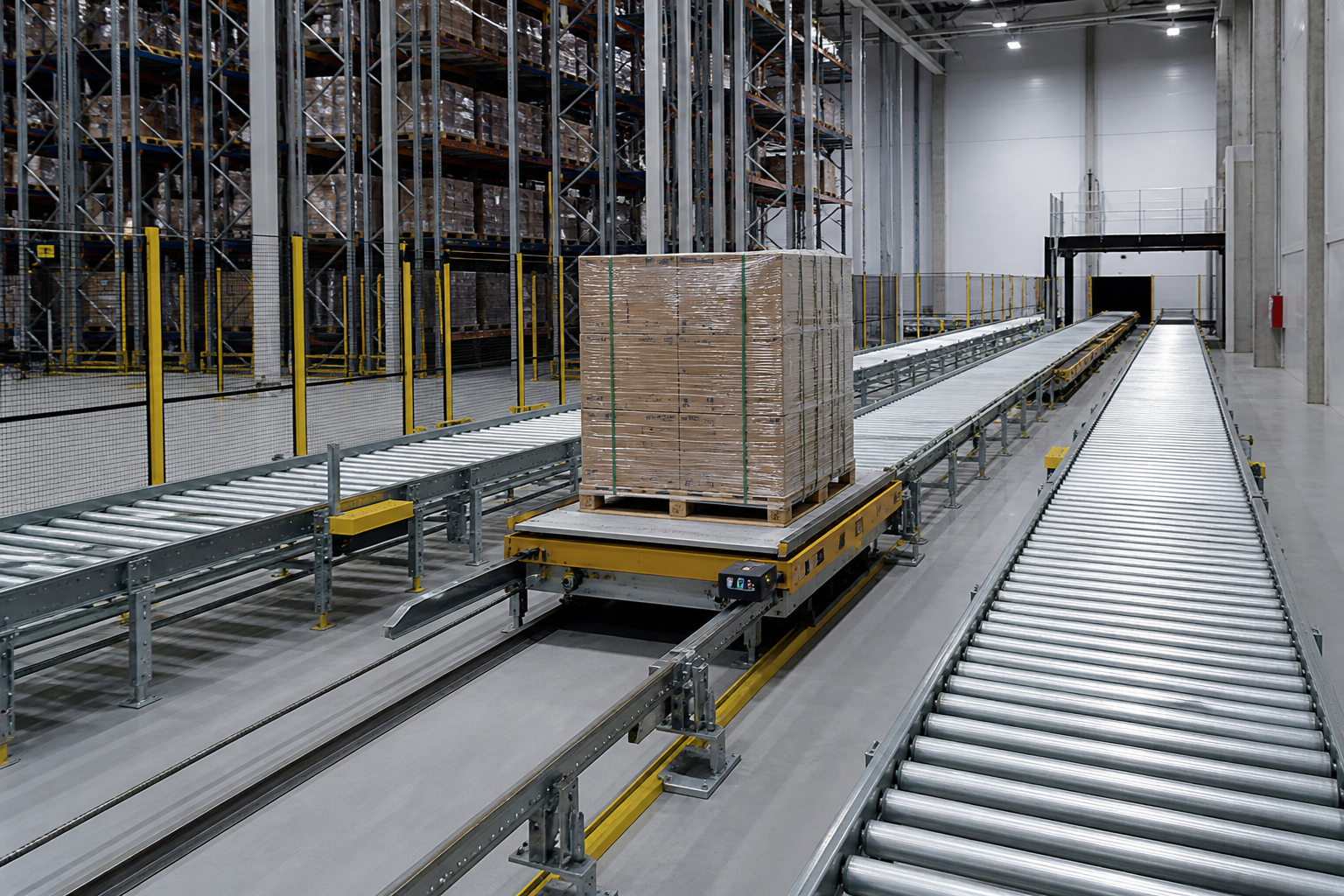
Transfer shuttle on a pallet conveyor line
A transfer cart that misses a station by 5 mm stops the line. Most such misses come from one source: wheel slip.
How each drive positions
A friction wheel drive moves the cart by traction between wheel and rail. Travel equals wheel rotation times circumference only as long as nothing slips. Acceleration, a wet or oily rail, wheel wear and load changes all change that relationship, so the controller needs an external position sensor to stop accurately.
A rack drive meshes. Travel per pinion revolution is fixed by geometry: s = z x pi x m. A 20-tooth module 3 pinion moves the cart 188.5 mm per revolution, every revolution, regardless of floor conditions.
Comparison
| Factor | Friction wheel | Rack and pinion |
| Slip under acceleration | Possible; limits acceleration | None - positive drive |
| Wet, oily or dusty rail | Traction falls | Not affected |
| Positioning | Needs external feedback for accuracy | Motor encoder follows travel directly |
| Long travel | Simple rail | Rack sections joined along the track |
| Noise | Low | Low with helical teeth; moderate with spur |
| Installed cost | Lower | Higher (rack along track) |
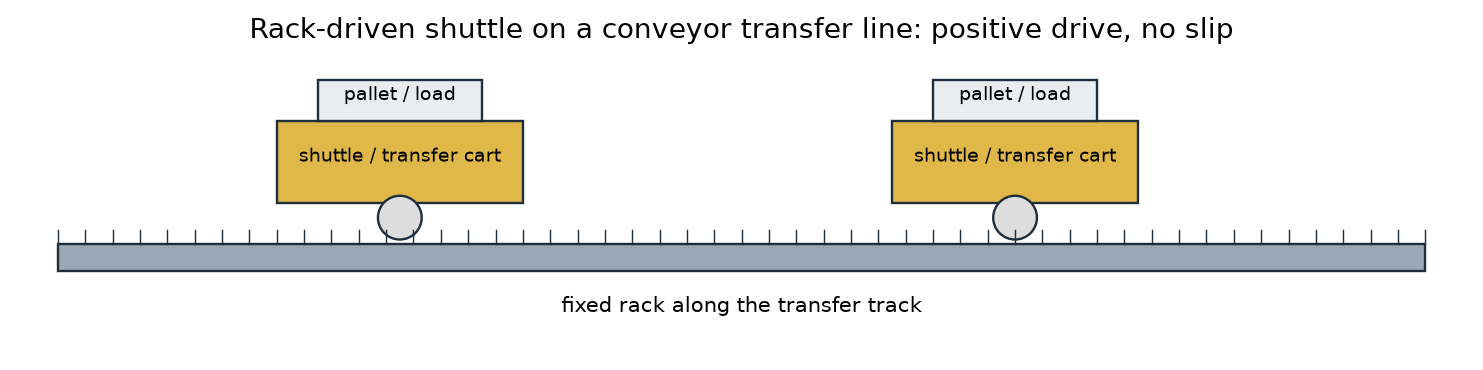
Fixed rack, pinion on the cart
When friction wheels are still right
· Short, light, slow carts where stopping accuracy is handled by mechanical stops.
· Lines with frequent track changes where a continuous rack is impractical.
· Budget-limited lines without servo control.
Specifying a rack drive for a conveyor
· Choose module from the tangential force: Ft = 2T / d.
· Milled racks at DIN 8 / DIN 9 are usually enough for transfer stations.
· Join sections with a gauge and dowel them.
· Use helical racks where speed or noise matters.
Summary
If the cart must stop at the same place every time, under any floor condition, a rack takes slip out of the equation.
For drawings, samples or a quotation, send us your rack, pinion or gear specification and quantity.
